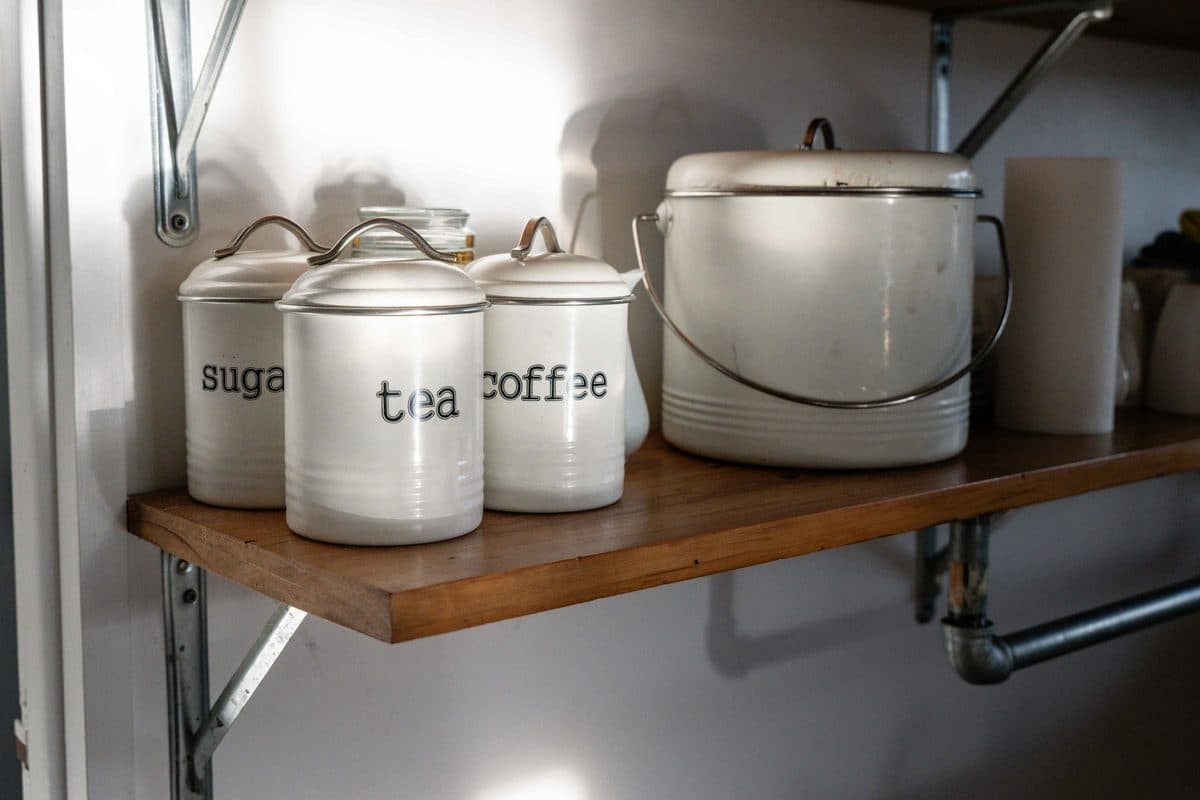
Labeled spice jars in a row on a wooden shelf, including pumpkin pie spice and smoked paprika. Photo via Unsplash.
Tiny kitchens do not run out of spices. They run out of places where you can see the label. The cumin ends up behind the paprika, so you buy another tin, and the cabinet door stops closing.
Spice rack organization for a cabinet is a visibility problem. You empty the collection once, keep what you cook with, and put it where the name faces you: a shallow drawer, a single shelf row, or a light rack on the door. The counter is a landing spot while you cook, not the spice rack.
🏠 Renter-friendly / no-drill — no screws into the cabinet.
Approx. — rough cost range in USD.
Key takeaways
Empty the jars onto the counter once and keep only what you still cook with.
Put a name on each jar you decant. Store-bought labels count.
Use a drawer insert when the jars are short enough to clear the drawer above.
On a shelf, face labels out in one row, or use a step so the back row shows.
A door rack is for light jars or packets, and only if the door still closes.
Buy a replacement when a jar is empty, not a second jar 'just in case.'
Why Should Spices Have One Home?
You need one of these, not all of them:
A drawer near the stove, if the jars are short.
A cabinet shelf you can see without unpacking it.
The inside of a door, for packets and a few light jars, if the door still closes.
Salt and pepper you grab every night can sit in a small tray by the stove. Everything else gets the one home. Two homes is how the second cumin jar happens.
How Do You Organize Spices in a Tiny Kitchen?
1Step 1: Put every jar on the counter
Step 1. The counter is where you sort, not where the jars live.
Pull every tin, jar, and packet out of the cabinet, the drawer, and the carousel that has been spinning in place since you moved in. Wipe the shelf while it is empty.
The bottles in the photo are the sorting moment: a handful of jars on the counter, next to the stove, with the rest of the kitchen still usable. That is the right size for a sort. It is the wrong size for a permanent display. When the sort is over, the counter goes back to being a counter.
As you handle each jar, make three piles:
Cook with it. You know the smell, and you have used it in the last few months.
Keep, but not in front. Baking spices, a cuisine you cook once in a while.
Let go. No name, no smell, or a duplicate of a jar you already kept.
Do not taste anything that looks off. If you cannot tell what it is, it does not go back in front. Letting the duplicates go is the same edit as how to declutter a small apartment. This cabinet is just the spice shelf.
2Step 2: Make the label readable
Step 2. A handwritten name beats a matching jar you cannot identify.
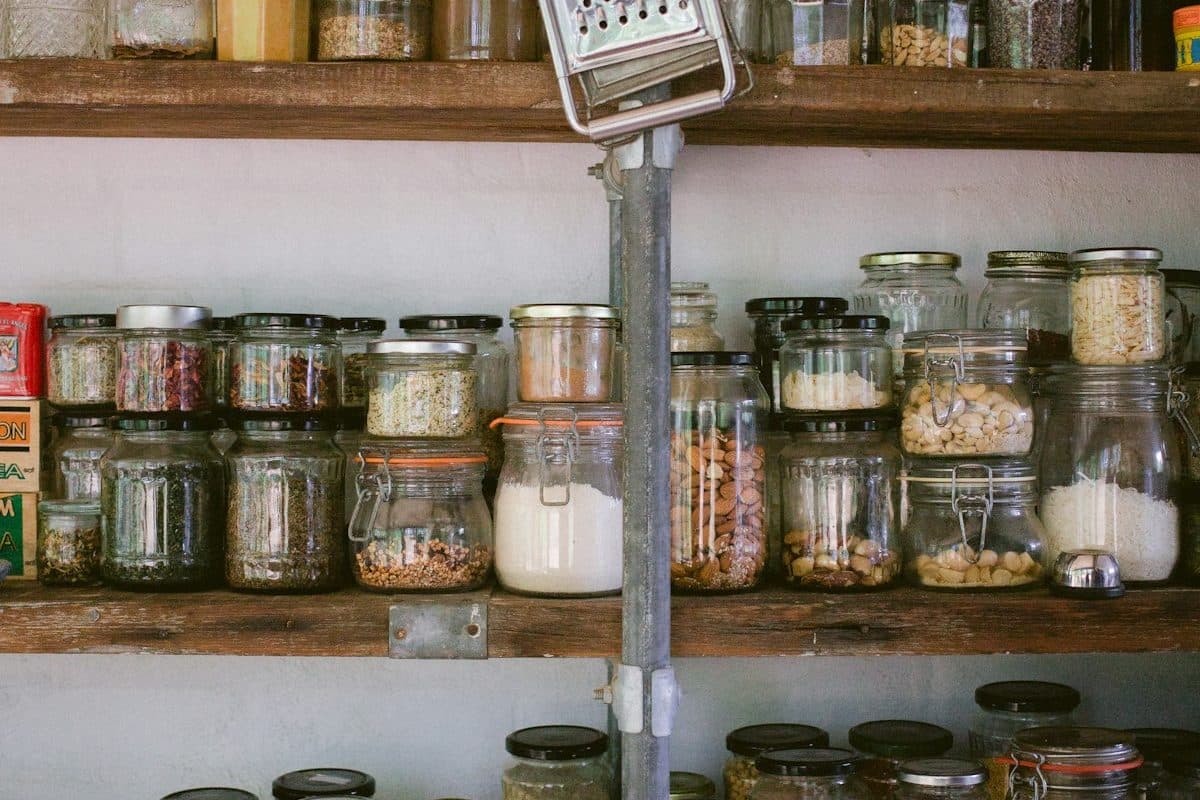
The jars in the photo are a simple version of the goal. Glass, a lid, and a strip of tape with the name written where you can read it.
You do not have to decant everything. Decant the five or ten you use most, if you want uniform jars. Leave the others in the container they came in when that label is already clear.
Tape and a marker are enough. Approx. $0–$8 if you buy tape.
Write the name on the lid and the side if the jar will live in a drawer. In a drawer you see lids. On a shelf you see sides.
Skip a full matching set until the edit is done. Jars you do not need are clutter with better lids. Approx. $10–$25 for a small set, if you still want one after the sort.
The shelf on the cover of this guide is the same idea with printed labels: one row, names forward, no second row hiding behind the first.
3Step 3: Use a drawer if the jars are short
Step 3. The jars get a lane. They do not share a pile with the plates.
A drawer works when you can see the lids and the drawer still closes. The drawer in the photo has plates in one section and a block of small jars in another. Copy the split. Spices get their own lane, not a gap behind the dishes.
Check the height before you buy an insert. Close the drawer with the tallest jar inside. If it catches, that jar stays on a shelf.
A slim insert or a row of the shortest jars. Approx. $8–$20. 🏠 It sits in the drawer. No screws.
Put the names on the lids.
Keep this drawer for spices, or for spices plus one other short category. Do not also make it the junk drawer.
If your only drawer is already the utensil drawer, do not evict the spatulas. Use the cabinet instead, and let two small tins share a slot if that is all the drawer can spare.
4Step 4: Face the labels on a cabinet shelf
Step 4. If you can read the label, you will not buy a second jar.
The shelves in the photo are a shop display, not a rental cabinet. The lesson still fits a cabinet at home: jars in rows, labels forward, nothing stacked in front of the name.
In a cabinet that is one jar deep, a single row is the whole system. In a deeper cabinet:
A tiered step lifts the back row. Approx. $10–$20. 🏠
A turntable helps in a corner cabinet where you cannot see the back. It is a bad fit on a narrow shelf, because round trays waste the corners.
Everyday jars in front, occasional jars behind or up high.
Do not line the shelf with so many jars that you have to remove three to reach one. That is the pile you just emptied. The pantry container calculator can count the jars on the shelf you measured.
The cabinet that holds the rest of the food still needs zones. Spices are one zone, not the whole shelf. Small pantry organization covers the other zones.
5Step 5: Use the door only if it still closes
Step 5. An open door shows the gap a rack has to live in.
The cabinet in the photo is not a kitchen spice rack. It is a door standing open in front of empty shelves. That is the test. Close the door in your mind with a rack on the inside. If the rack would hit the shelf, the frame, or the hinge, it does not go on that door.
🏠 On a kitchen cabinet:
Measure from the inside of the door to the shelf, with the door almost shut.
Choose a rack shallower than that gap. Packets and flat tins need less depth than round glass.
A hook-over rack that uses the top of the cabinet door needs no screws. Approx. $8–$20.
Put the rack on the door, then shut it before you fill every slot. Add jars until the door still closes without a shove.
A door full of glass jars is heavy. Packets, wraps, and a short row of light tins are the load a cabinet door is good at. Heavier jars belong in the drawer or on the shelf.
Door hooks in the rest of the apartment follow the same "it still closes" rule. That guide is over-the-door storage.
6Step 6: Put them back and buy one at a time
Step 6. A small set you can name is the collection worth putting back.
The spoons in the photo are a cooking set, not a cabinet: chili, a yellow powder, salt, herbs, seeds. That is the scale to copy. The spice home has a capacity. When the row is full, a new jar means an old jar leaves, or the new one does not get bought.
After the jars are back:
Wipe the counter. The sort is over.
Put salt and pepper, if you keep them out, on one small tray.
When a jar is nearly empty, finish it and replace that one.
Once a month, look at the front row. If a jar has not moved, it can go to the "sometimes" bin.
Budget: tape, a step, and a door rack or a drawer insert are often $15–$40 together. Buy the insert after the edit. Empty jars do not need a new rack.
All-steps checklist for spice organization in a drawer, on a door, or in a cabinet.
How Do You Keep a Spice Row You Can Read?
You are done when you can name the jar in front without moving the one behind it. The drawer, the shelf, or the door can do that. The counter cannot, once dinner is over.
How do I organize spices in a small kitchen cabinet?
Take the jars out, wipe the shelf, and put back a single row with the labels facing you. If the cabinet is deep, add a tiered step or a wire rack so the back row is readable. Keep everyday spices at eye level. Move baking spices you rarely use to a higher shelf or a labeled bin.
Is a drawer or a cabinet better for spices?
Use a drawer if you have one that is not already the only home for utensils, and if the jars are short enough that the drawer closes. Use a cabinet shelf if that is the space you have. A door rack is the third option, for a few light jars or flat packets, after you measure the gap.
How do I use a spice rack on a cabinet door?
Measure the inside of the door and the space in front of the shelf. The rack has to be shallower than that gap or the door will not close. Hook-over and removable racks are the renter versions. Keep it to light jars and packets. A door full of glass is a lot of weight on the hinge.
Should I pour spices into matching jars?
Only for the ones you use often, and only if you label them the same day. Matching jars look tidy and hide the name if you skip the label. Leave the rest in the store container if the label is already readable.
How many spices does a small kitchen need out?
Keep the ones you reach for in a normal month within arm's length of the stove. A dozen jars is plenty for many kitchens. The rest can live in a bin you pull out for baking or a specific cuisine. If you cannot name a jar, it does not need a front-row spot.
How do I stop duplicate spice jars?
When a jar is low, put it on the shopping list and finish it before you open a second. Group duplicates on sorting day and combine them only if they are the same spice and both still smell like themselves. Write the name on any jar you refill.
Get the small apartment checklist
One short email a week with a small-space fix that actually works in a rental. You also get our printable room-by-room checklist. No spam, unsubscribe anytime.