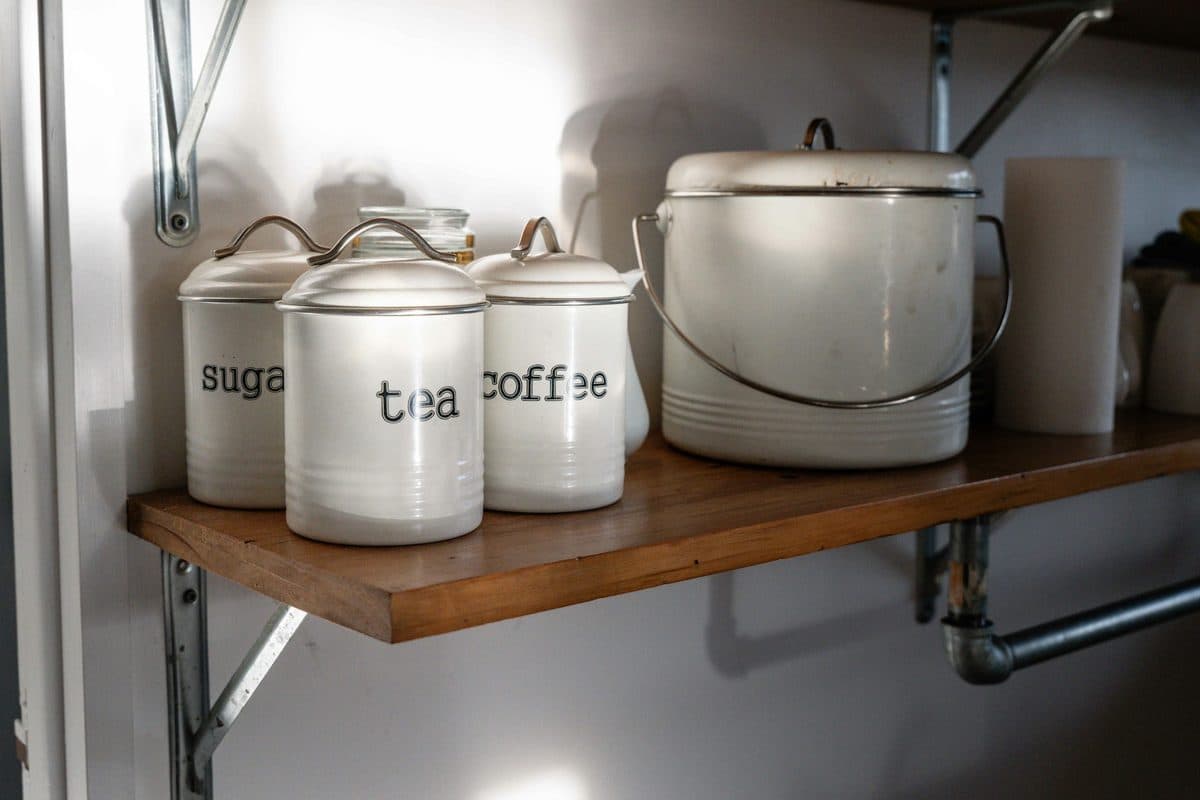
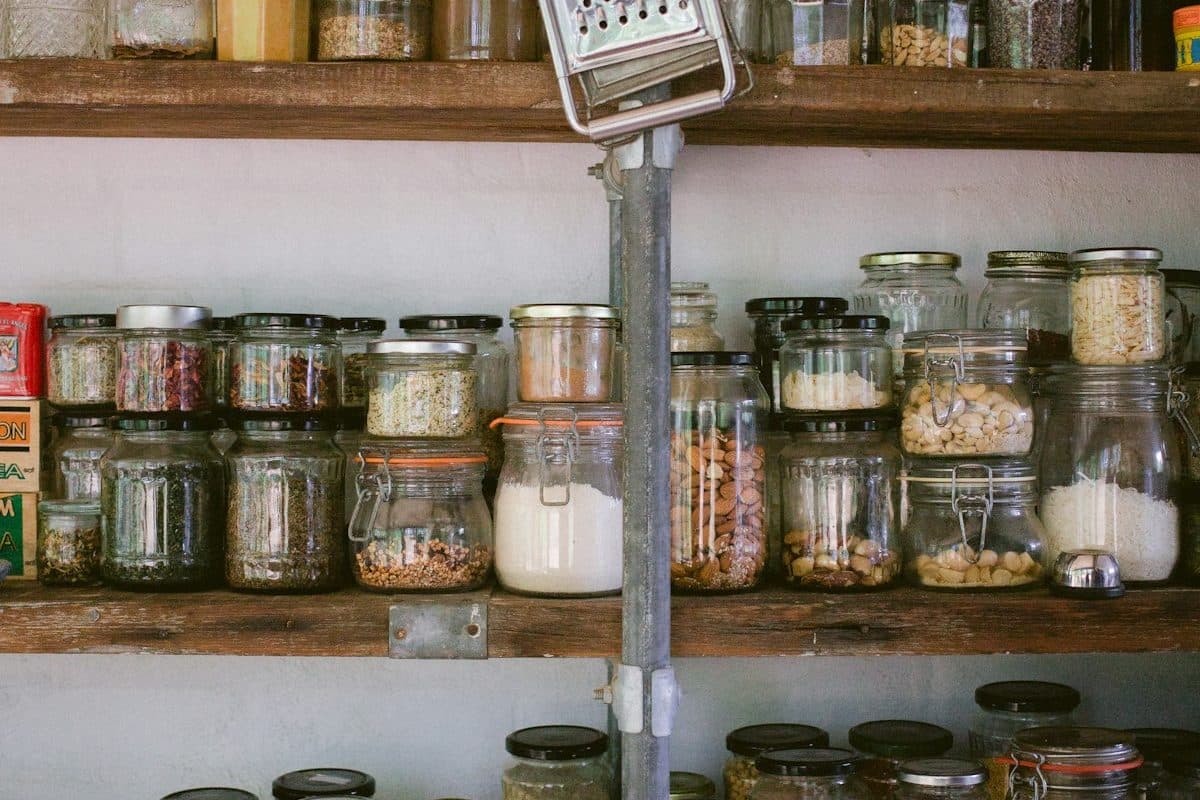
White canisters on a wood pantry shelf, with tea and coffee labels readable and a third canister at the left edge. Photo via Unsplash.
A label is not a matching set of jars. It is the words that keep the shelf findable after the bag is gone.
Pantry labels work when each one answers two questions from where you stand: what is this, and when did it open. Packets that still have a printed name can share a bin label such as Breakfast or Snacks. Jars that look alike need the item name. If you poured the food out of a bag, the new label has to carry the date you just threw away.
Costs below are approximate ranges in USD. Tape and a marker are $0–$5. A pack of printable or vinyl labels is often $5–$15.
Key takeaways
Line 1 is the name. Line 2 is opened, written year-month-day. Line 3 is the date copied off the package.
Bins of packets get a category such as Breakfast or Snacks. Matching jars get the item name.
Decant flour, sugar, rice, oats, and cereal. Leave cans, and anything with a use-by you might cover, in the package.
Masking tape and paper stickers need clean, dry glass, metal, or smooth plastic.
A common US printable sheet is 1 inch by 2 5/8 inches, 30 labels on a letter page. UK and AU packs are often A4. Use the template on the pack.
Best-by is about quality. A UK or Australian use-by on perishable food is about safety. Copy the words. Do not translate them into a guess.
What Do You Write on a Pantry Label?
1Step 1: A category on the bin, an item on the jar
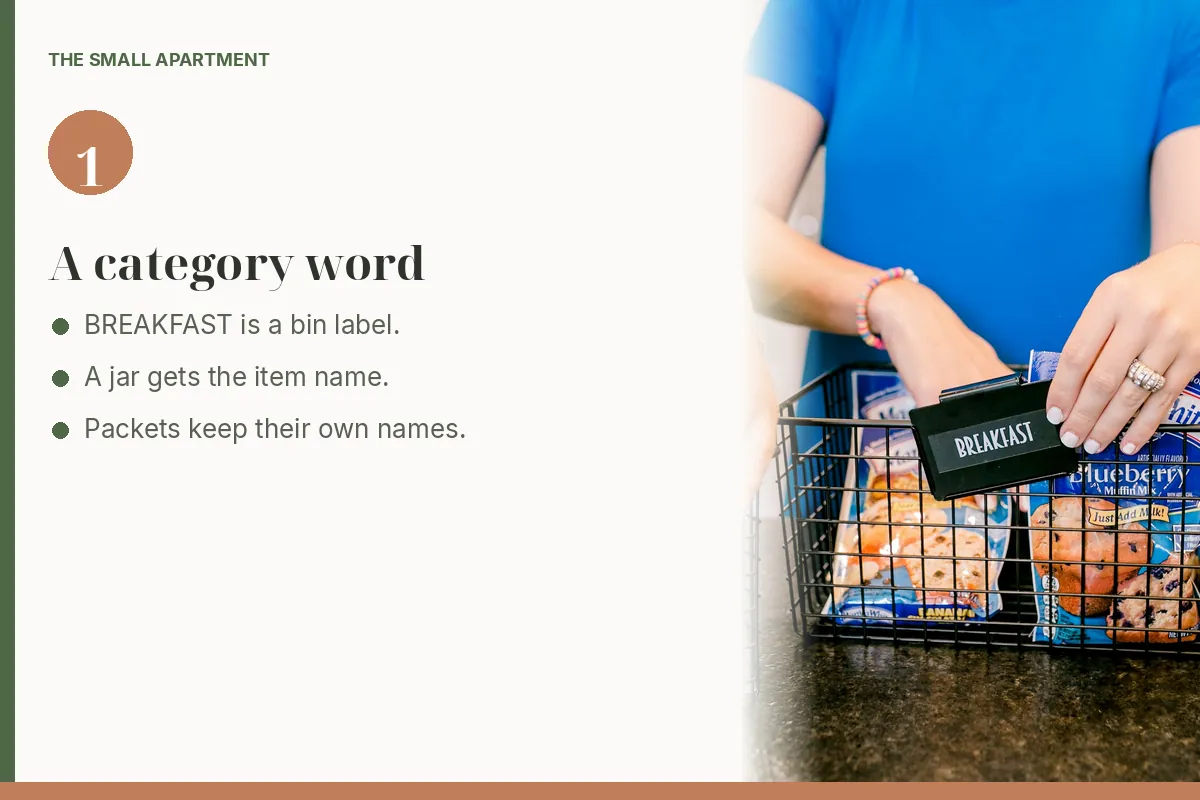
Step 1. BREAKFAST is a category label. The packets inside still have their own names.
The basket in the photo is labeled with one word. The food is still in its package. That is the right label for a bin. You are not renaming every muffin mix. You are naming the group so the next person puts the new box in the same basket.
Use this order. Three lines, and stop.
Name. A category for a bin of packages: Breakfast, Snacks, Grains, Baking. The item name for a jar: Oats, Flour, Brown sugar. Not both a cute name and a code.
Opened. The day the bag or box was opened, written year-month-day (2026-10-19). Skip this line if the package is still sealed.
Package date. Copy the words on the bag: best by, best before, or use by, plus the date printed there. Do not invent a new date.
Write it large enough to read without picking the container up. If you have to lift the jar to your face, the letters are too small. A strip about 1 inch tall is enough on a small jar. A bin label can be wider than it is tall, stuck on the face that points at you, not on the lid.
The canisters on the cover use one word each. Tea and coffee are readable from the front. That is the test.
Which Label Sticks to Which Container?
2Step 2: Tape and paper like clean, dry glass
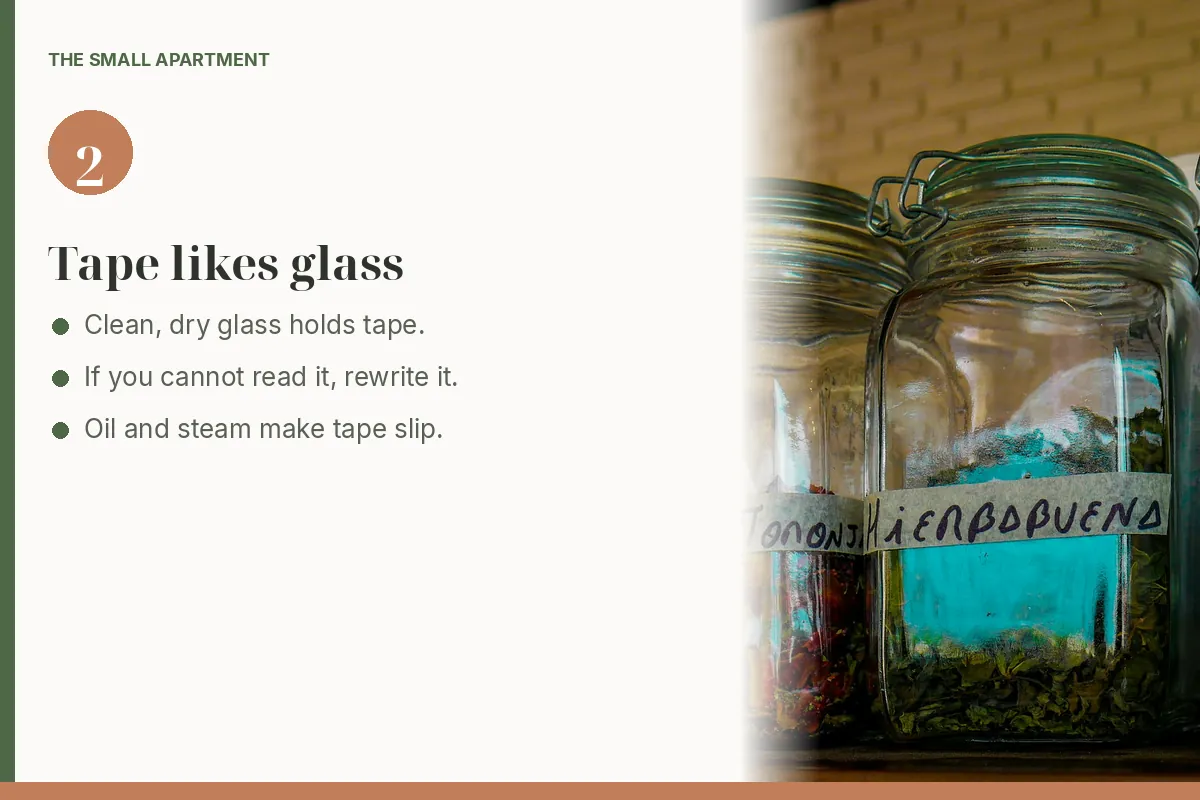
Step 2. Handwritten tape on glass. If you cannot read the word from the shelf, rewrite it larger.
The jars in the photo are the same shape, so the tape is doing the real work. A few of those words are hard to read. That is the failure mode. The tape stuck. The handwriting did not. Rewrite any label you cannot read at arm's length.
What sticks where, if the surface is clean and dry:
Label
Sticks to
Slips or fails on
Masking tape or painter's tape and a marker
Clean glass, painted metal, smooth plastic
Oil, frost, silicone, a very textured lid
Paper sticker or a printable sheet
The same smooth, dry surfaces
A steamy kitchen, the dishwasher, a greasy lid
Vinyl or a label sold as waterproof
Plastic and glass, if the pack says so
Whatever surface the pack excludes. Read it
Chalkboard sticker and a chalk marker
Whatever the sticker base is rated for
Smudges. The base still has to stick
Grease pencil on glass
Glass only
Plastic. It also wipes off, which is the point
Paper tape in a steamy kitchen softens and curls. If the shelf is next to the kettle, use a label the pack calls waterproof, or a grease pencil on glass. Removable tape is the renter version on containers you will take to the next apartment. It should come off the jar. It should not be asked to survive a dishwasher unless the pack says it will.
Do not stick the new label over a safety date you still need. On a box you are keeping, put a small "opened" sticker beside the printed date, not on top of it.
When Should You Decant Into a Container?
3Step 3: Only when the new label can carry the old date
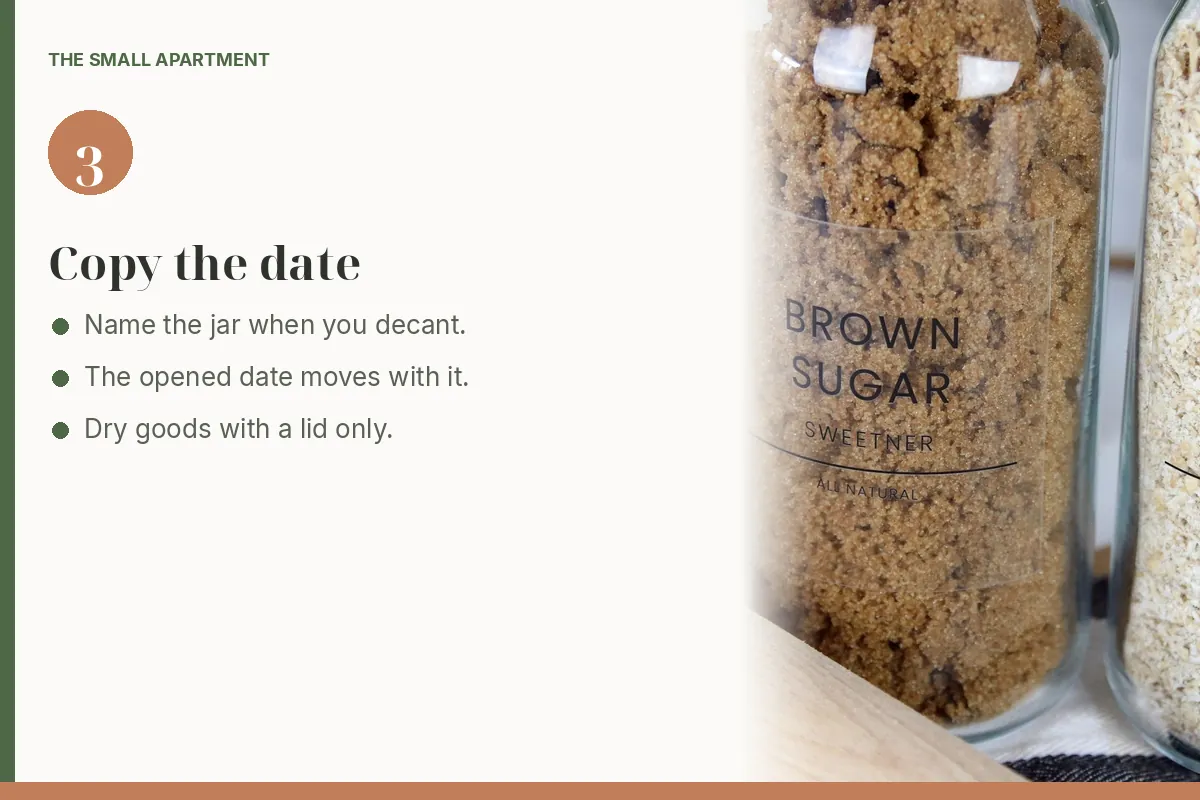
Step 3. Brown sugar, named on the glass, with oats beside it. The opened date still has to be added if it is not on the bottle.
The brown sugar bottle in the photo is decanted, and the name is readable. The oats bottle beside it is the same job. What the photo does not show is an opened date. A pretty label with only the name is half done. Write the date before the bag goes in the bin.
Decant these, into a dry container with a lid that actually closes:
Flour, sugar, brown sugar, rice, oats, cereal, nuts.
Anything in a floppy bag that will not stand on the shelf and that you will use more than once.
Leave these in the package:
Unopened cans and jars. They already have a label. A second label does not help.
Single-serve packets and boxes. They go in the category bin from step 1.
Oil that came in a dark bottle. A clear jar lets light in. Keep the bottle.
Anything you will not be able to identify once the bag is gone, unless the new label is already written.
Square or rectangular containers waste less shelf than round ones. You do not need a matched set. A reused glass jar is fine if it is clean, dry, and labeled. The container rules for the shelf itself, including what not to decant, are in small pantry organization.
Write the label, stick it on, then pour. If you pour first and label later, two white powders become a guessing game.
4Step 4: Do not cover a package that is already labeled
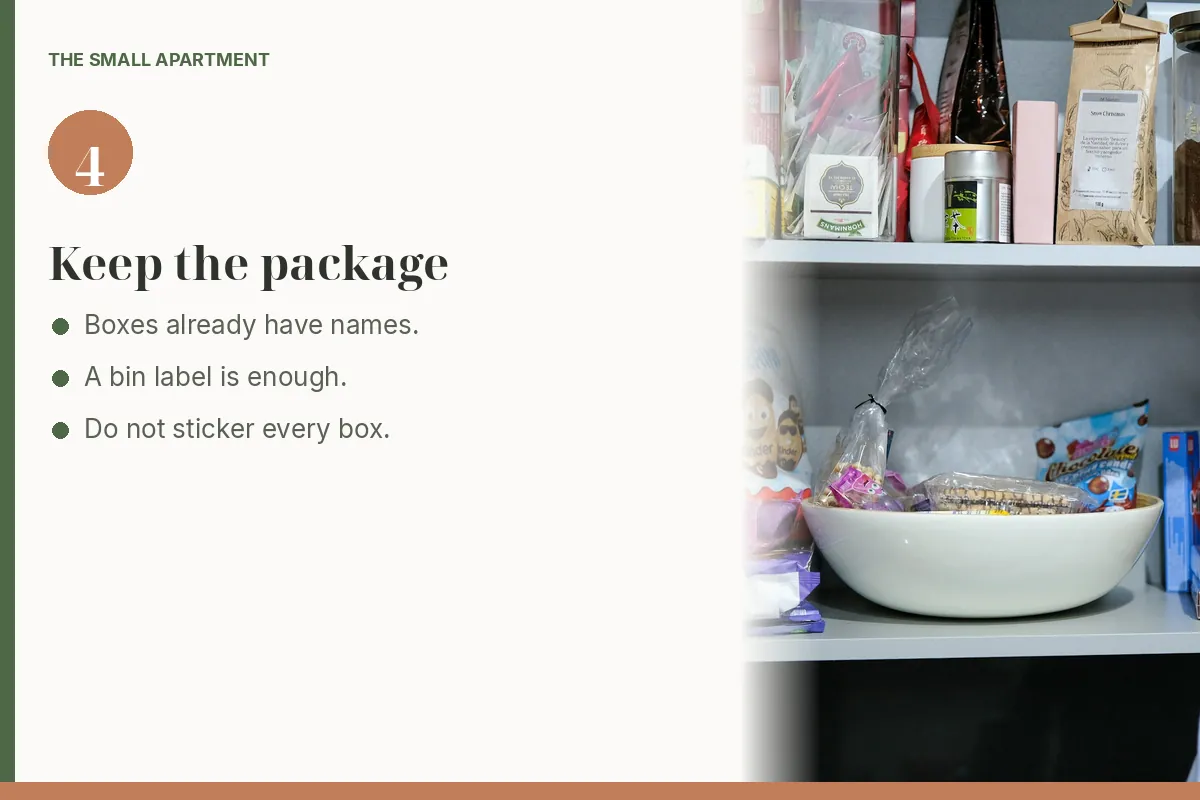
Step 4. These packages already have names. They need a bin label, not a new sticker on every box.
The shelf in the photo is packages, jars, and boxes, each with printing on it. Decanting this pile into matching jars would hide the dates and take a Saturday. The label system for this shelf is one word on a bin, and the packages stay as they are.
Pull anything open, stale, or without a name you trust. Then group what is left into the bins you labeled in step 1. The zone those bins belong on is the pantry organization system, not this page.
How Do You Date a Label?
5Step 5: Year-month-day, and copy the package words
Step 5. Write the date down before the bag is gone. Year-month-day, then the words from the package.
The notebook is the habit. The date style matters because this site's readers are in the US, the UK, Canada, and Australia, and 03/04 is not the same day in all of those places.
Write 2026-10-19, or 19 Oct 2026. Do not write 10/19 or 19/10.
Then copy the package. The words are not interchangeable.
In the US, a "best if used by" or "best by" date is about quality for most foods, not a safety date. Infant formula is the exception people already treat as a hard stop. The USDA's food product dating guidance is the reference.
In the UK, a use-by date on perishable food is about safety. Do not eat the food after that date, and do not rely on how it looks. A best before date is about quality. That distinction is from the Food Standards Agency.
In Australia and New Zealand, Food Standards Australia New Zealand treats use-by as the date after which the food should not be eaten, and best before as quality.
In Canada, the Canadian Food Inspection Agency treats a best before date as quality and freshness, not a general safety date.
Copy the words that are printed. Do not upgrade a best-before into a use-by, or the other way around. If you are unsure whether a food is still safe, follow the date type on the package and your local food safety guidance. A label on a jar is not a new safety test.
Spices are the jars most likely to look identical once they are decanted. Name them on the front, which is the labeling half of spice organization in a tiny kitchen.
What Goes on a Printable Label Sheet?
6Step 6: Put the name on the face you can see
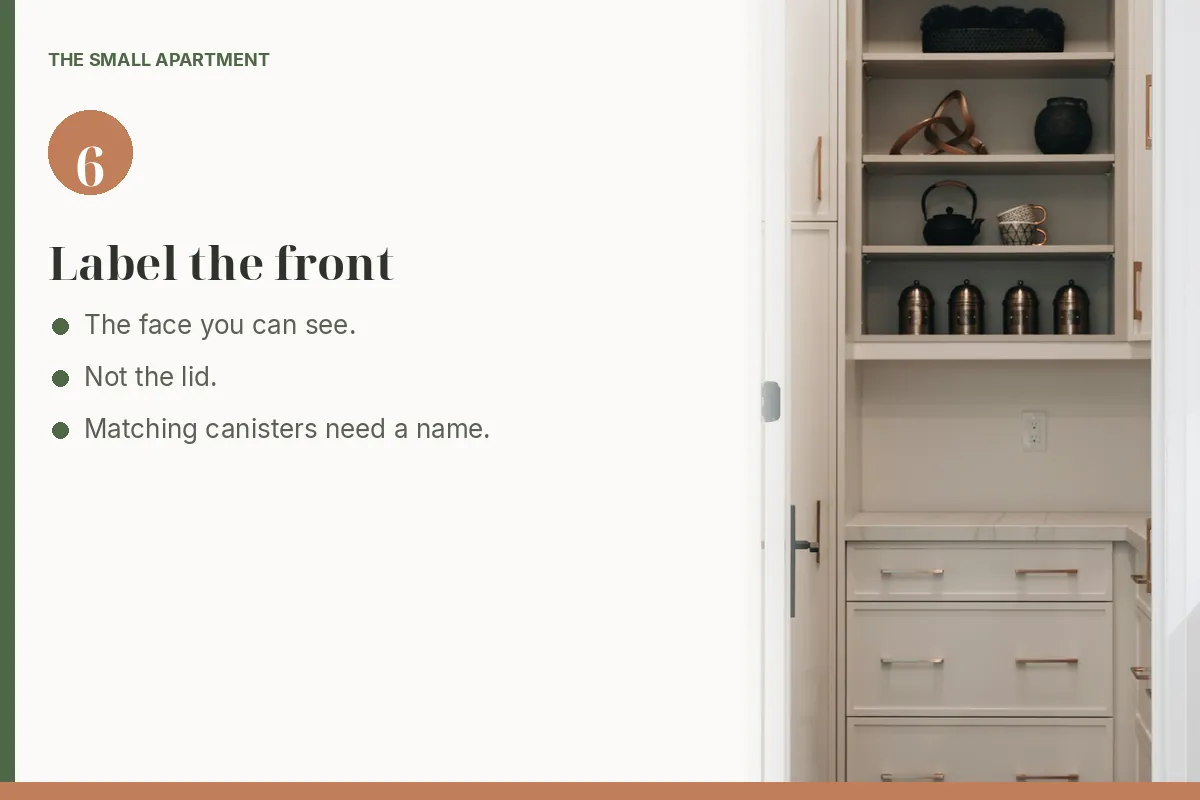
Step 6. A row of matching canisters with nothing you can read from the doorway. The label belongs on the front face.
The canisters in the photo are a matched row in a narrow cabinet. From the doorway you cannot tell them apart. A label on the lid only helps after you have already pulled the jar down. Stick the name on the front, upright, at the height of your eye when you open the door.
A printable sheet is the fast way to make those fronts match. A common US template, often sold as Avery 5160 or a compatible sheet, is 1 inch by 2 5/8 inches, 30 labels on a letter page. That is wide enough for "Brown sugar" and a date. In the UK, Canada, and Australia, the pack is often A4. Use the template code printed on the pack you bought, not a US letter template on A4 paper. The labels will not line up.
Print, or copy this block by hand onto tape. One row is one container.
Name
Opened
Package date, copied
Oats
2026-10-19
best by ____
Flour
best by ____
Sugar
best by ____
Rice
best by ____
Breakfast (bin)
leave blank if packages are sealed
Snacks (bin)
leave blank if packages are sealed
Blank lines are the point. You fill them from the bag in your hand, not from a list of dates someone else guessed.
Label or Leave the Package?
Food
Label
Container
Open bag of flour, sugar, rice, oats, cereal, nuts
Item name, opened date, package date
Dry, lidded, airtight
Packets and boxes you can already read
One category word on the bin
The package stays
Unopened can or jar
None, unless the shelf needs a bin name
Leave it
Spices that look alike
Item name on the front
A jar you can close
Oil from a dark bottle
Keep the bottle's own label
Do not move it to clear glass
Budget: one roll of masking tape and a marker will label a small cabinet. Buy a printable sheet only if you want the fronts to match. Approx. $0–$15. The jars can be ones you already washed.
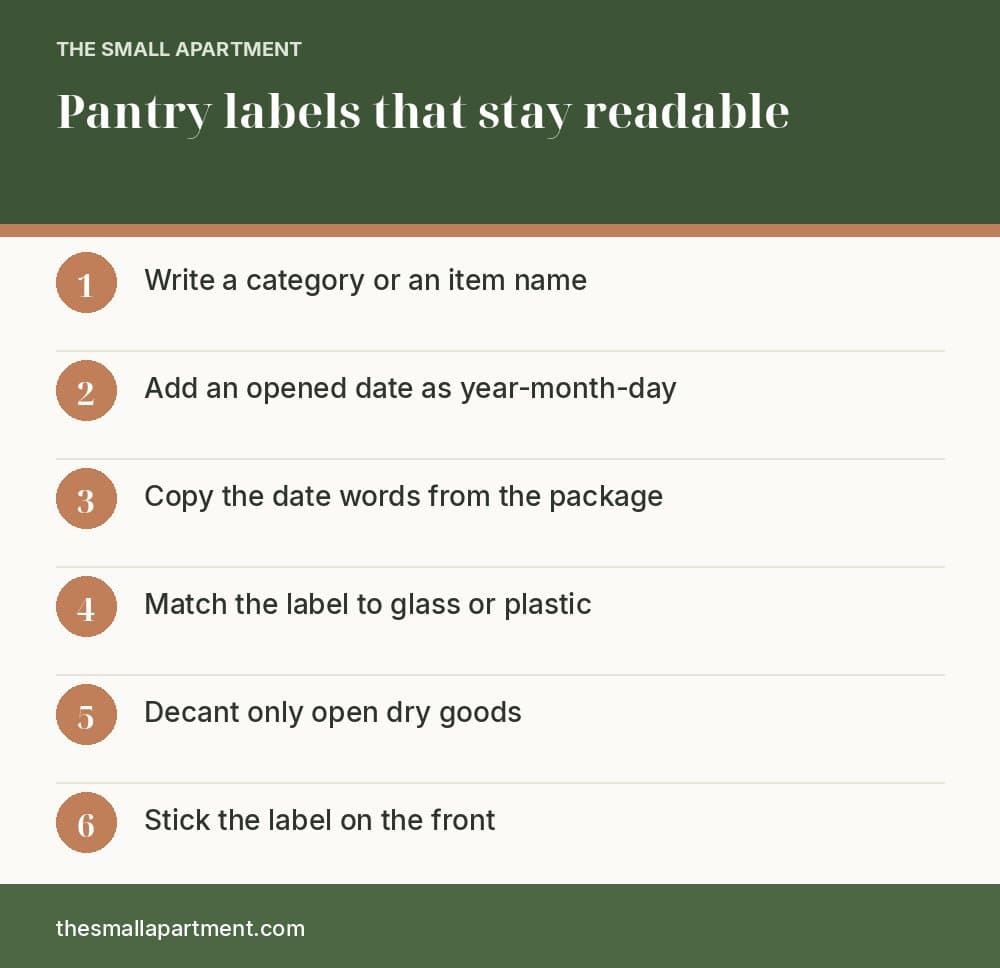
All-steps checklist for pantry labels that stay readable.
What Does a Finished Label Look Like?
You can read the name from the doorway. If the food was poured out of a bag, the opened date and the package date are on the jar, in an order that does not depend on which country you learned dates in. The packets are still in a bin that says what they are.
Three short lines. The name (Oats, or a bin category such as Breakfast). The day you opened it, as year-month-day, if the food left its package. The date printed on the package, copied with the same words, such as best by or use by. If you cannot read it from the shelf without picking the jar up, the letters are too small.
Which pantry labels stick to glass, plastic, and metal?
Masking tape, painter's tape, and paper stickers stick to clean, dry glass, painted metal, and smooth plastic. They slip on oil, freezer frost, and silicone. A vinyl or waterproof label is the one to try in a steamy kitchen, if the pack says so. Chalkboard labels still need a sticker base that matches the surface. A grease pencil on glass needs no sticker and wipes off.
Should I decant food into matching containers?
Decant open bags of dry goods you will keep using: flour, sugar, rice, oats, cereal, and nuts, into a dry airtight container. Copy the package date onto the new label before you throw the bag away. Leave unopened cans and jars in their own labels. Leave single-serve packets in a labeled bin. Do not pour oil from a dark bottle into a clear jar.
How do I date a pantry label?
Write the opened date as year-month-day so a US, UK, Canadian, or Australian kitchen reads it the same way. Copy best by, best before, or use by exactly as printed. In the US, best-if-used-by is a quality date for most foods. In the UK and Australia, a use-by date on perishable food is a safety date. Do not eat food after a use-by date. When you are unsure, follow the date type on the package and your local food safety guidance.
What size are printable pantry labels?
A common US sheet, often sold as Avery 5160 or a compatible template, is 1 inch tall by 2 5/8 inches wide, with 30 labels on a letter-size page. That fits a small jar front. In the UK, Canada, and Australia, buy the A4 or letter template named on the pack and use that file. Masking tape about 1 inch wide is the no-printer version.
Do I need to label every single item?
No. Label the bin or the zone when the packages are already readable, which is the rule in the pantry organization system guide. Label the jar when you decant, or when several jars look the same. Spices are the second case, and they have their own guide.
Get the small apartment checklist
One short email a week with a small-space fix that actually works in a rental. You also get our printable room-by-room checklist. No spam, unsubscribe anytime.