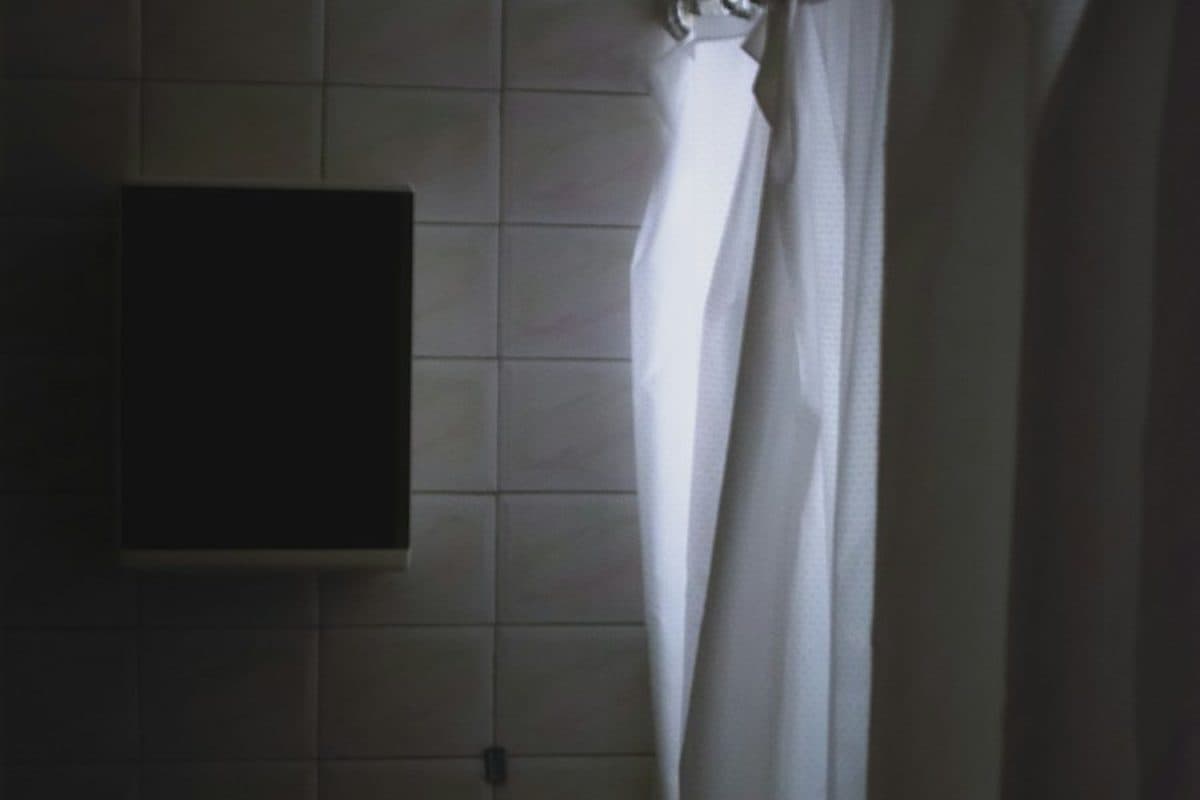
A white shower curtain on metal rings against square tile, next to a dark wall cabinet. Photo via Unsplash.
A basic tension rod is a spring or twist rod wedged between two surfaces. No screws. It comes down when you move. That is the whole appeal, and it is also the limit.
Renter friendly DIY ideas like this one work when the rod is doing a light job: a curtain, a row of shirts, a few spray bottles, lids standing on edge. They fail when someone asks the same rod to be a shelf.
The short version of tension storage, including floor-to-ceiling poles, is in renter-friendly storage without drilling. This page stays on the basic rod: where it holds, how to measure and tighten it, and what to swap in when it slips. The cabinet around an under-sink rod is in under-sink organization.
Costs below are approximate ranges in USD.
Key to labels:
🏠 Renter-friendly / no-drill — the rod presses. It does not screw in.
Approx. — rough cost range in USD.
🏠 A tension rod is removable. It is not a grab bar, and it is not a shelf. If the package lists no weight rating, treat the rod as a curtain rod.
Key takeaways
Measure the opening at the height the rod will sit, then use the narrowest number.
Both rubber ends need a flat spot. Raised tile and bowed walls will not hold.
Use a basic rod for a curtain, shirts, lids, or spray bottles.
Do not hang a shelf, books, or a person from a spring rod.
A grab bar is screwed in. A tension rod is not a grab bar.
When the rod creeps, switch to a rated pole, a real shelf, or a hook.
Where Do Tension Rods Work in an Apartment?
Five spots, all of them light:
Shower curtain. A rod across a tub, if both walls are flat and the width is inside the printed range. A curtain on rings is the job. A caddy on that same rod is extra weight. Skip the caddy unless the package says the rod can hold one.
Window. A short cafe curtain inside the window frame. Not floor-length blackout panels on a wide wall.
Closet. A second rod under the one you have, for shirts and skirts, when both sides of the closet are solid.
Under the sink. Spray bottles or a cloth hung from S-hooks, inside the cabinet, not in the way of the plumbing.
Cabinet divider. A short rod holding lids, baking sheets, or cutting boards on edge, if they are light enough that the rod does not bow.
A basic rod is often approx. $5–$20. Buy the one whose printed range includes your measurement with room to spare. A rod stretched to its maximum is the one that falls. The tension rod size calculator picks a typical range where that width sits in the middle.
How Do You Measure, Install, and Tighten a Tension Rod?
1Step 1: Measure at the height the rod will sit
Step 1. The tape in the photo is on a work board. Measure your opening the same way: at the height the rod will actually sit.
Walls are not always parallel. A number taken at the counter can be wrong two feet higher.
Measure left to right at the height you want the rod.
Measure again a little above and a little below.
Write down the smallest of those numbers.
Inches or centimetres both work. Match the unit on the package. US, UK, CA, and AU rods are sold in both.
The pencil mark in the photo is a workshop habit. You do not need to mark the rental wall. A note on your phone is enough.
Then install it:
Wipe both contact spots. Dust and soap film are slippery.
Set the rod in place. Twist the adjustable end, or let the spring expand, until both rubber cups sit flat.
The rod should stay when you let go, before you hang anything.
Hang the light item. Tug down once. If the rod creeps, spins, or bows, take it down.
Do not keep twisting until the paint dents. A cup that presses in means the wall is too soft for this rod.
2Step 2: Use it for a curtain, not as a bracket rod
Step 2. Grommet panels on a rod that crosses the window. A tension rod does not include wall hardware.
The navy curtains in the photo hang from a black rod on grommets, in front of a window. A rod that has to reach past the frame and attach to the wall is mounted hardware. A tension rod can copy the curtain. It cannot copy that hardware.
What works:
A cafe curtain on a rod that fits inside the window frame, for privacy on the lower half.
A shower curtain on flat tub walls, on rings, with nothing else hanging from the rod.
What does not:
Wide grommet panels like the ones in the photo. The rod has to extend past the window, and the ends need a wall that may not be flat or close enough.
Blackout drapes. The fabric is heavy, and a spring rod will walk down the casing.
If you want that full curtain look and the lease allows hardware, you need a real rod and brackets, or written permission. If it does not, use a shorter curtain inside the frame. 🏠
3Step 3: Add a closet rod only on solid sides
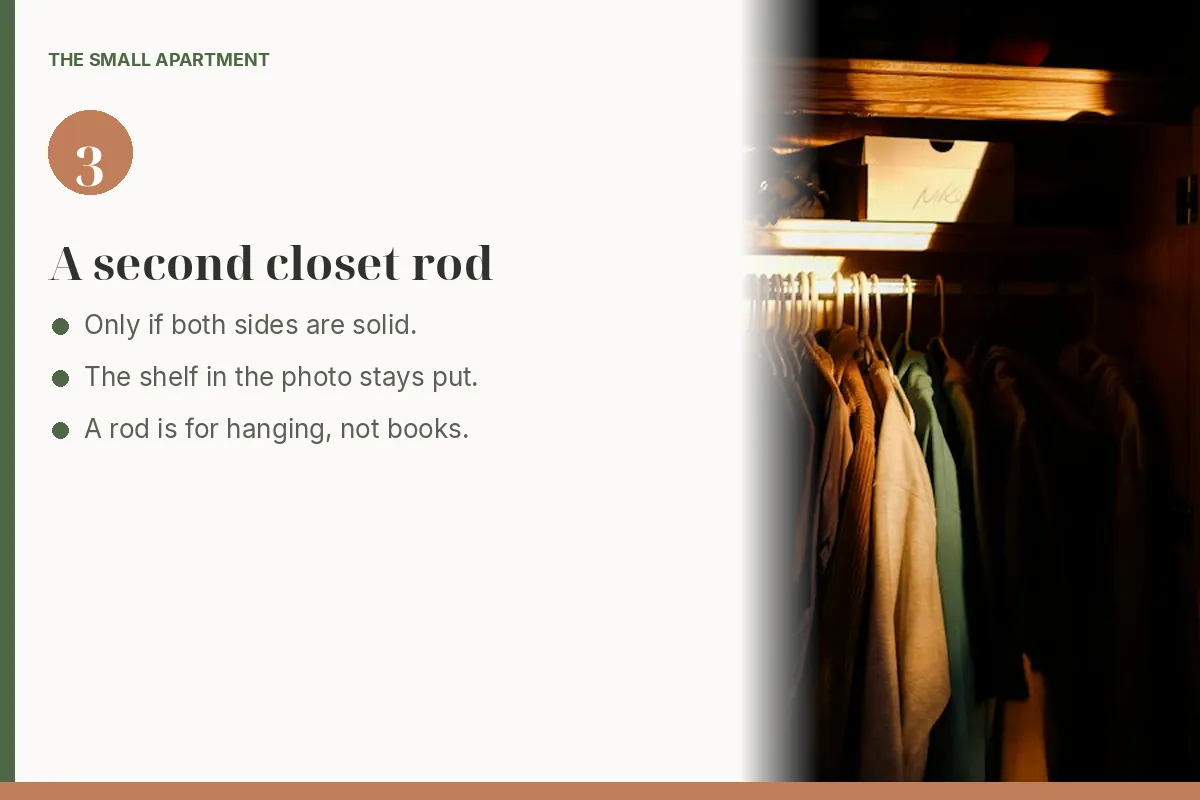
Step 3. This closet already has one rod and a fixed shelf. A second rod is for hanging, not for replacing the shelf.
The closet in the photo has one rod of shirts, a wooden shelf with a box, and a jacket on the door. The shelf is built in. Leave it. A tension rod does not become that shelf.
A second rod helps when the high rod is full of long clothes you rarely wear and the shirts are crushed underneath. Put the tension rod lower, for shirts and shorter pieces, if both sides are solid wood or a solid closet frame.
Skip it when:
The side is a wire panel.
The side is drywall that gives when you press a thumb into it.
You planned to lay a board across the rod.
Hangers plus shirts is the load. A row of coats can be too much on a long span. One or two coats can live on the door instead. That is a different tool, covered in over-the-door storage. Take shirts you do not wear off the rod before you add another one. That is how to declutter a small apartment, applied to one closet. The rest of the closet is in small closet organization.
4Step 4: Keep cabinet rods light
Step 4. The dishes are on a real shelf. A rod, if you use one, goes inside the closed cabinet and stays light.
The kitchen in the photo has a wood shelf of glasses and plates, a sink, and white doors that are shut. Nothing in that picture is a tension rod, and that is the point. Dishes stay on the shelf. The rod, if you add one, lives inside the sink cabinet or a tall cupboard.
Inside a cabinet, a short span holds more than a long one. Useful jobs:
Spray bottles on S-hooks under the sink, hung so they clear the pipes.
Lids or a baking sheet standing on edge.
A divider so trays stop falling over.
Not useful:
Stacks of plates.
Cast iron.
A "shelf" made from a board on the rod.
Close the door before you call it done. If the rod or the bottles stop the door, the rod is in the wrong place. The layout for the rest of that cabinet is in under-sink organization. If the cupboard holds food, the rod is only a small piece of a small kitchen pantry. Pasta stays on a real shelf.
5Step 5: Know the surfaces where the ends slip
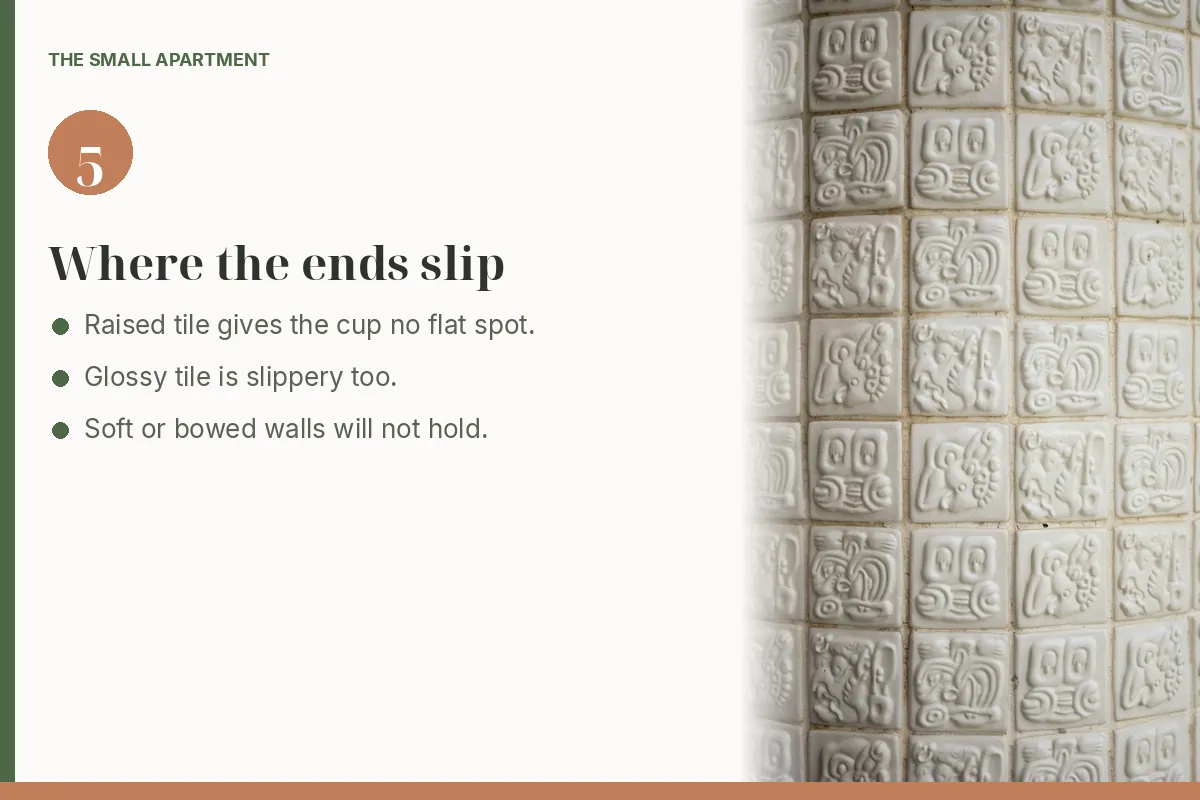
Step 5. A rubber cup cannot sit flat on tile that sticks out.
The tile in the photo is the failure in one picture. Each square is raised and patterned. A rubber end needs a flat circle. This wall does not have one.
Take the rod down if you have any of these:
Heavy loads. Books, a shelf board, a laundry bag, a person. A curtain rod is not a ladder.
Glossy tile. The cup looks seated and still slides, especially in a steamy shower.
Raised, bumpy, or heavily textured tile, like the photo.
Uneven ends. One side on a door casing, the other on tile, so the cups are not square to the surface.
Soft or bowed walls. If the cup dents the paint or the drywall flexes, the rod will loosen.
A span at the maximum printed on the package.
A shelf kit clipped to a basic spring rod. That product is a different pole. The ratings live in the no-drill storage guide.
The cover of this guide is the curtain job: rings on a rod, flat square tile, a cabinet on the wall. A tension rod can hold that curtain. It cannot do the job of a grab bar, which is mounted to the wall and meant to hold a person. Do not hang your weight from a tension rod.
Recheck a shower rod now and then. Humidity and soap film make a grip worse over time. If it has dropped, it is done in that spot.
6Step 6: Put real weight on a shelf
Step 6. This is the load a rod should never carry.
The shelves in the photo are full of books, some stacked flat. That weight belongs on wood that is built to hold it, or on a bookcase standing on the floor.
Safer swaps when the rod is the wrong tool:
Job
Use this instead
Books, dishes, small appliances
A bookcase or a fixed shelf
Shelves you cannot drill for
A floor-to-ceiling pole rated for shelves, on a solid floor and ceiling
A removable strip rated for that weight and that paint, or lean the frame
Lids and spray bottles
The short cabinet rod from step 4
A curtain wider than the frame
Permission for brackets, or a shorter curtain
🏠 The pole and the door hook still come out when you leave. The bookcase was never in the wall.
Should You Use a Rod, a Pole, or a Shelf?
Tool
Holds
Does not hold
Basic tension rod 🏠
Curtain, shirts, lids, spray bottles
Shelves, books, a person
Rod at its maximum length
Often nothing for long
Anything you care about
Floor-to-ceiling pole 🏠
Shelves, if the package says so
A drop-ceiling tile
Real shelf or bookcase
Books and dishes
Needs floor space
Over-the-door hook 🏠
A coat, a towel
A full closet
Budget: one rod for the shower or the closet is often enough. Approx. $5–$20. Buy a second only after the first one survives a tug test.
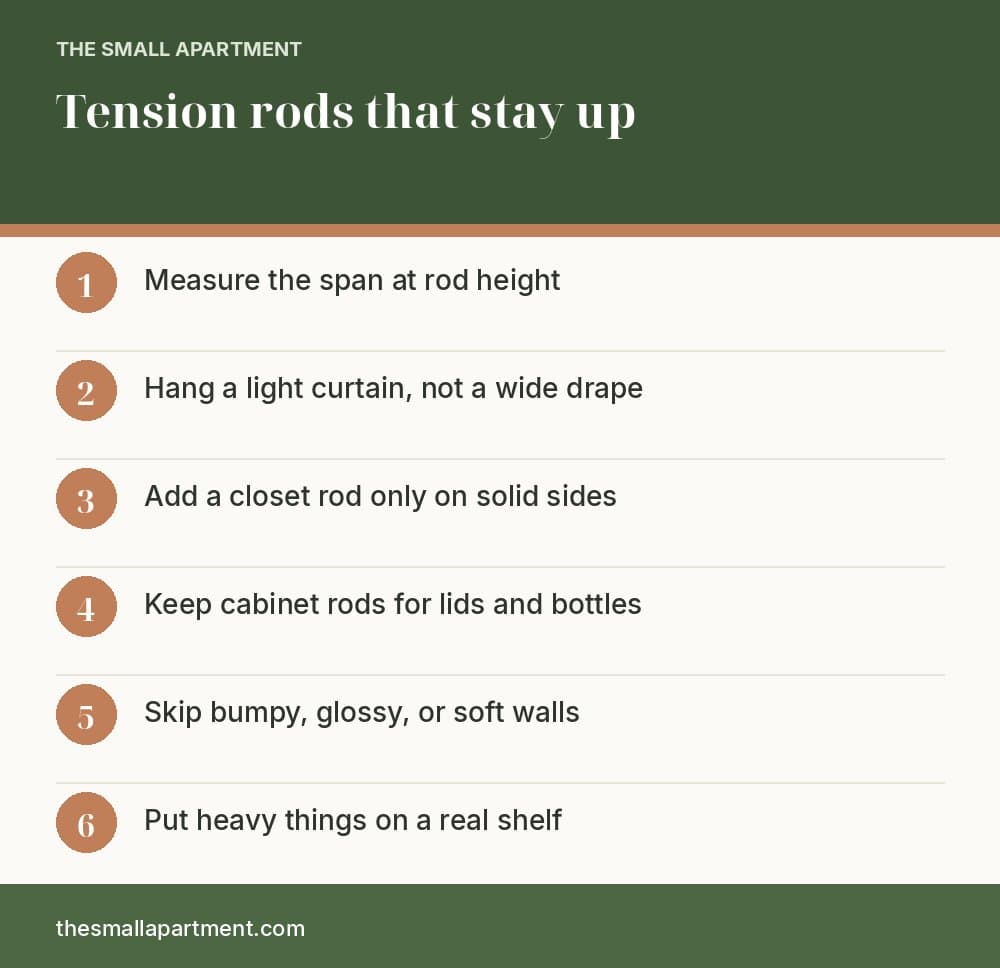
All-steps checklist for tension rod hacks that stay on the wall.
How Do You Keep a Tension Rod From Falling?
You are done when the rod holds a curtain or a row of shirts and does not creep after a tug. If it only stays up while you hold your breath, that opening needs a shelf, a rated pole, or nothing.
They are a no-drill option for light jobs, and they come down when you move. They are safe when both ends press on a flat, solid surface and the load is a curtain, shirts, or a few light bottles. They are not safe as a grab bar, a bookshelf, or a place to hang your weight.
Why does my tension rod keep falling?
The usual causes are a span at the rod's maximum, ends sitting on glossy or bumpy tile, a wall that flexes, or a load heavier than a curtain. Wipe the contact spots, shorten the span if you can, and tug the rod after you hang the item. If it creeps, take it down.
Can I put a shelf on a tension rod?
Not on a basic spring rod sold for curtains. Shelves need a floor-to-ceiling tension pole that lists a weight rating for shelves, pressing on a solid floor and a solid ceiling. Books and dishes belong on a real shelf.
Do tension rods work on tile?
They can, if the tile is flat and the rubber cup sits fully on it. Glossy tile is slippery. Raised or embossed tile gives the cup nothing flat to press against. A rod that walks down the tile is telling you to stop.
Can I add a tension rod in a closet?
Yes, for a second hanging rod, if both sides are solid. Shirts and shorter clothes can go on the lower rod. Do not use it as a shelf, and do not wedge it against a wire panel or drywall that dents when you press it.
What should I use instead of a tension rod?
Use a real shelf or bookcase for books and heavy kitchenware. Use a rated floor-to-ceiling pole if you need shelves and cannot drill. Use an over-the-door hook for a coat. Use a short rod inside a cabinet only for lids and spray bottles.
Get the small apartment checklist
One short email a week with a small-space fix that actually works in a rental. You also get our printable room-by-room checklist. No spam, unsubscribe anytime.