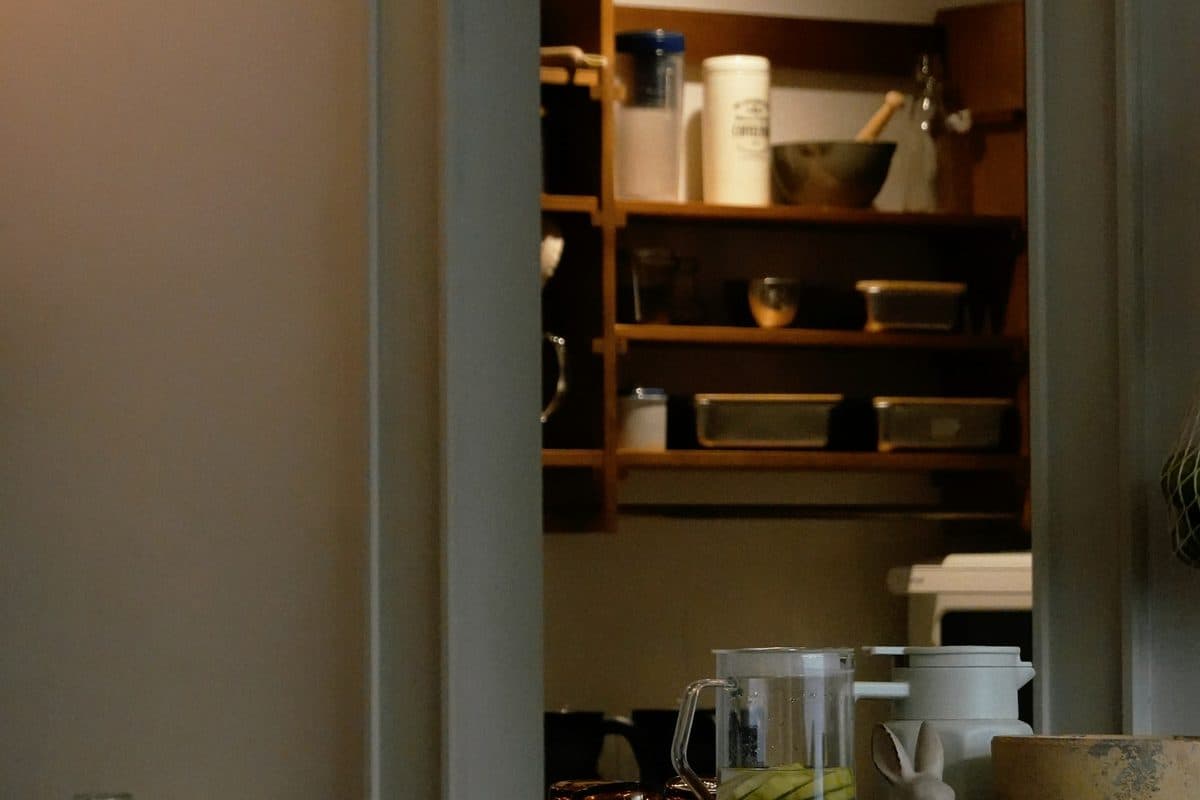
A pantry seen through a doorway, with wood shelves holding a coffee canister, a bowl, and metal bins, and a glass pitcher on the counter in front. Photo via Unsplash.
A shelf that is 12 inches deep, or shallower, does not have a back row you can forget. The food you keep is the food you can name from the doorway.
Measure the clear depth, then keep labels facing you. A bin that is deeper than the shelf sticks out, and the door will not close. A soup can is often about 3 inches across. Measure the can you have. Two may fit front to back on a 12-inch shelf. A third is a reach.
The cover is a pantry seen through a doorway. Wood shelves hold a coffee canister, a bowl, and metal bins. A glass pitcher sits on the counter in front. Copy the shelves you can see into. Leave the pitcher and the dishes on the counter out of the pantry. Those belong in a cabinet, or in the sink.
The full pass for a cabinet or a closet pantry, including zones and a door rack, is in small pantry organization. This post is only the depth. Zones, once the shelf is measured, are in the pantry organization system.
Key takeaways
Measure the clear depth, from the back wall to the front lip, in inches or centimetres.
12 inches is about 30 cm. Shallower than that is the same job, with less room for a second can.
A soup can is often about 3 inches across. Measure the can you own before you plan a second row.
If you cannot read the back label without moving the front item, the back item does not belong there.
A bin or a turntable has to be narrower than the clear depth, or the door hits it.
Labels go on the front. The lid is what you see only when you lift the jar off the shelf.
How Deep Is the Shelf, Really?
1Step 1: Measure to the front lip
Step 1. Each cubby holds one tin. Your shelf is wider than a cubby. Measure it before you copy the idea.
The photo is a shop wall of wood cubbies. Each opening holds one tin, label facing out. That is stricter than a 12-inch shelf. The part to copy is that you can name every tin without moving another one.
At home, measure the clear depth:
Tape from the back wall of the shelf to the front lip, not to the outside of the cabinet.
Write the number down. 12 inches is about 30 cm. A shelf at 8 inches, or about 20 cm, is the same job with less room.
Measure the height between shelves too. A tall box fails on height even when the depth is fine.
A soup can is often about 3 inches across, about 7.5 cm. Measure yours. On a 12-inch shelf, two of those cans can sit front to back with room to spare. On an 8-inch shelf, two is tight and a cereal box on its deep side may not fit at all. Turn the box, or move it.
The cubbies in the photo are a shop. You do not need a wall of them.
What Should Face You?
2Step 2: The label, not the back of the can
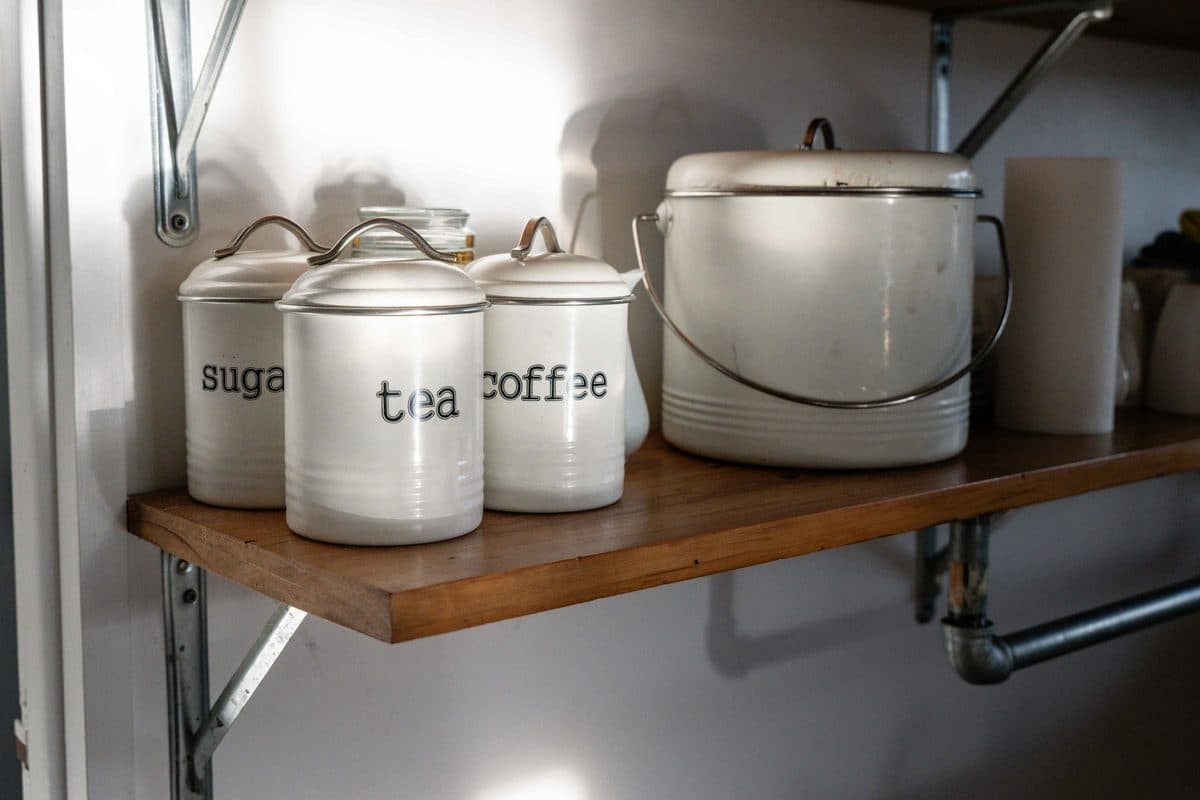
Step 2. Sugar, tea, and coffee, written on the front. The pot behind them is the thing a shallow shelf should not hide.
The photo is a wood shelf with three white canisters. The words sugar, tea, and coffee are on the front. A glass jar and a white pot sit behind them. The shelf looks like one canister deep until you notice the pot.
On a 12-inch shelf, the front is what you cook from. The pot behind the canisters is easy to forget. If you cannot see it without lifting a canister, it does not live there. Move it to a taller gap, or use it this week.
Labels go on the front, not the lid. You are looking at the face of the jar. A lid label is for a shelf you look down on, and a shallow cabinet is not that. Printable fronts, and where to stick them, are in pantry labels.
The canisters in the photo are a matched set. You do not need a matched set. A jar you already own, with the word on the front, is the same system.
Which Bin Will the Door Hit?
3Step 3: Deeper than the shelf means it does not fit
Step 3. Built-in pull-out drawers in a wide kitchen. A 12-inch rental shelf is not this cabinet.
The photo is a large kitchen. Three pantry cabinets stand open, with wood shelves, glasses, dishes, and pull-out drawers. An island and a row of chairs fill the foreground. Those drawers were built for that cabinet. They are not a bin you can order for a shelf that measures 12 inches.
Do this with the number from step 1:
The bin, front to back, has to be shorter than the clear depth. If the shelf is 12 inches, a bin at 12 inches will still hit the door once the door has a lip or a rack.
Leave about an inch, about 2.5 cm, so the door closes without touching the front.
A turntable has to be narrower than the clear depth. Measure the diameter. If it is wider than the shelf, it hangs off, and the door stays open.
If you are about to buy a jar, the pantry container size calculator is the check against the depth you just wrote down. Buy after the number, not before.
The island and the chairs are a different room. Ignore them.
How Tall Can the Jar Be?
4Step 4: One stack, and only if the shelf above clears
Step 4. The small jars are stacked two high because nothing is above them. A cabinet shelf is not this table.
The photo is a bare table against a white wall. A tall jar of spaghetti, a jar of oats, and two stacks of small jars. Nothing sits above them, so the stacks are fine. A cabinet shelf has a board overhead.
Measure the gap between your shelf and the one above it. The jar, including the lid, has to be shorter than that gap. A spaghetti jar like the tall one in the photo needs the full height. If it does not fit standing up, it does not get laid on its side in front of everything else. It moves to a taller gap, or it stays in the box if the box fits better.
The two small jars stacked on the right are the only stack that makes sense on a short gap, and only if you can lift the top jar without hitting the shelf above. Two stacks of mystery spices are how a shallow shelf fills up with food you do not use.
What About Open Shelves?
5Step 5: One row, handles included
Step 5. One row of pots. The handles stick forward. On a closed cabinet, that forward inch is what the door hits.
The photo is a wall of open wood shelves. Pots sit in one row. Bowls and plates sit in one row. A blue pot is alone on the top shelf. A sink is below. There is no door, so a handle can stick out.
A cabinet door changes the rule. Count the handle, the lid knob, and the spout in the depth. If any of them pass the front lip, the door hits them. Slide that pot to a shelf with more height and less traffic, or hang it only if you already have a hook that is not over the stove flame.
Open shelves like these are not a narrow pantry, and the brackets are screwed into the wall. In a rental, do not add a screwed shelf to solve a 12-inch cabinet. Use the shelf you have.
The fern and the blue pot are extra. One row of the pots you use this week is the idea.
What About a Short, Flat Tin?
6Step 6: Short is good, a lid label is not
Step 6. These tins are short enough for a low gap. The words are on the lids, which a shallow shelf hides.
The photo is a table of flat fish tins. Yellow Ortiz tins and a round tin sit with the labels on the lids. Nothing is on a shelf. You can read them because you are looking down.
A flat tin is useful on a short gap. The height is the reason. The lid label is the problem once the tin is on a shelf you look at from the front. You will see the rim, not the word.
Do one of these:
Stand the tin so the label faces you, if it is tall enough to stand and still clears the shelf above.
Write the word on the front, the same way step 2 labels the canisters.
Keep lid-up tins in a group of one food only, so you do not need to read each lid.
A rack on the door is the other place people try to win depth. Measure the gap between the front lip and the inside of the door first. The rack uses that gap. If a can already sits at the lip, the rack hits it and the door stays open. That measurement is the same one as step 1, just the other direction.
Measure the lip, face the labels out, and leave the door able to close.
What If There Is No Pantry Door?
Then the shelf is open, and the handle rule from step 5 is the whole limit. Food still faces you. A bin that hangs off the front is a hip, not storage. The zones for the rest of the cabinet are still the ones in small pantry organization.
Printable Narrow Pantry Checklist
Frequently asked questions
How do you organize a pantry shelf that is only 12 inches deep?
Measure from the back wall to the front lip. Keep one visible row, labels facing you. A soup can is often about 3 inches across, so two may fit front to back on a 12-inch shelf. A third is a reach. If the door hits the front item, that item is too deep.
What does 12 inches look like in centimetres?
About 30 cm. Measure your shelf in whichever unit the tape uses. The clear depth is the number that matters, not the outside of the cabinet.
Can you use a turntable on a shallow pantry shelf?
Only if the diameter is less than the clear depth. A turntable that is wider than the shelf hangs off the front, and the door will not close. Measure the turntable, then the shelf.
Should cans sit two deep on a 12-inch shelf?
Only if you can still read the back label, or you already know what it is because the front can is the same food. If the back can is a mystery, it comes forward or it leaves.
Do labels go on the lid or the front?
On the front, for a shelf this shallow. You are looking at the face of the jar, not the lid. A lid label helps only when the jar is stored where you look down on it.
What if the cabinet door has a rack?
Measure the gap between the front lip of the shelf and the inside of the door. A rack on the door uses that gap. If a can already sits at the lip, the rack will hit it and the door will stay open.
Get the small apartment checklist
One short email a week with a small-space fix that actually works in a rental. You also get our printable room-by-room checklist. No spam, unsubscribe anytime.