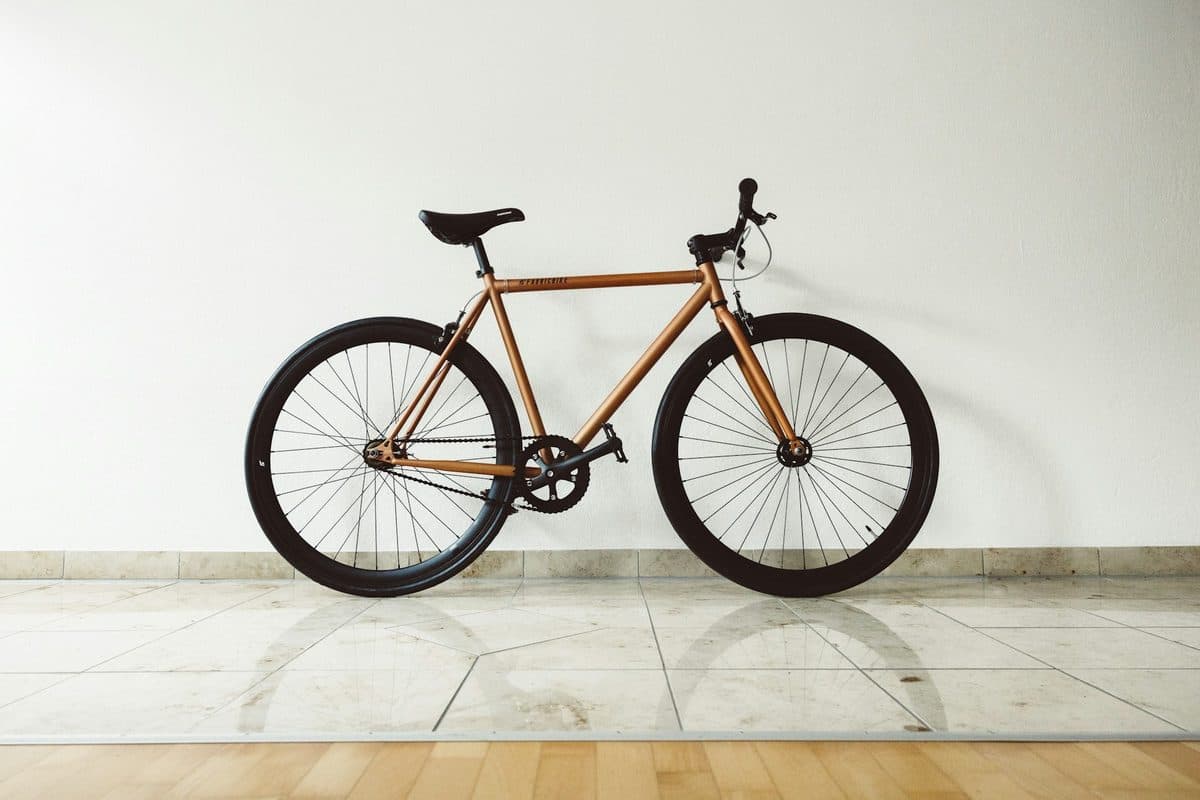
A brown bicycle standing indoors against a plain white wall, both wheels on a tile floor. Photo via Unsplash.
A bike in a small apartment is a long object with two wheels and a lease that often says no holes. The workable place for it is the floor.
Park it on the floor, out of the door swing. With both wheels on, you need a clear stretch of wall about as long as the bike. If you do not have that, take the front wheel off and lean the frame, or use a freestanding stand that does not screw into the wall. Adhesive hooks and a curtain-rod tension rod are the wrong rack. A mat under the tires is the right one when the bike is wet.
This is a common rental problem: the bike does not fit under the bed, and the walls are not yours to drill. The no-drill menu for everything lighter than a bike is in renter-friendly storage without drilling. Rods, and the jobs they cannot do, are in tension rod hacks for renters.
The cover photo is a bike indoors against a plain wall, both wheels down. That length is the storage problem. The room around it is larger than a studio. Copy the floor, not the square footage.
Key takeaways
Look at the bike with both wheels on. That length is the wall you need.
Park it in a corner the door does not cross. A rug under it is fine. The walkway is not.
A kickstand keeps it up. A mat or tray under the tires catches water. The photo of a bare floor is the before, not the goal.
Take the front wheel off when the clear wall is shorter than the bike. The wheel is the extra length.
Adhesive hooks and unrated tension rods are for light loads. A bike pulls outward and down.
Leave the path from the door to the rest of the room empty. The bike is furniture with wheels.
How Much Wall Does a Bike Need?
1Step 1: Look at the bike with both wheels on
Step 1. Both wheels on, indoors, nothing in the wall. The frames above it are not holding the bike.
The photo is a bicycle against a white wall, both wheels on a wood floor. Nothing is screwed in. The frames higher up are art. They are not a rack.
Stand the bike where you hope it will live, both wheels on, and look:
Does the handlebar pass the door, the dresser, or the bed?
Is the clear wall at least as long as the bike, with a little room so the pedal is not in the walkway?
Can you still open the nearest door all the way?
If the answer to the length question is no, go to step 4 and shorten it. Do not decide it "basically fits" while the front wheel blocks a drawer.
A studio that is already zoned into sleep, cook, and sit does not have a spare zone for a bike in the middle. The layout habits are in studio apartment organization. The bike takes a corner, not a new room.
Where Should the Bike Stand?
2Step 2: Use a corner the door does not hit
Step 2. A bike in a corner beside a cabinet, wheels on a wood floor, a rug in front. The corner is the spot. The rug is not a rack.
The photo shows a bike leaned in a corner next to a white cabinet. A patterned rug is in the foreground. The bike is not hanging. That is the default.
Good corners:
Beside a bookcase or a cabinet, where the bike is already out of the path.
Along a wall that no door crosses.
On a hard floor, with a small mat under the tires if you need one.
Bad corners:
The one the entry door opens into.
In front of a closet you use every day.
Across the strip of floor you walk at night.
If the only rug you own is the one in the photo's foreground, do not roll a dirty bike onto it and call that storage. A cheap tray or a towel under the contact patch is the mat. The rug can stay a rug.
The path from the front door, including shoes and keys, is a different system, in small entryway storage. The bike should not be the thing you step over to reach the keys.
How Do You Keep It Upright and Off the Floor Finish?
3Step 3: Use the kickstand, and put something under the tires
Step 3. Kickstand down on a bare floor. Add a mat or a tray if the tires drip. The photo does not have one yet.
The photo is a close view of a rear wheel, the chain, and a kickstand on a dark floor. The kickstand is doing the job. The floor is bare.
Use that as the checklist, not as the finished setup:
Kickstand down, or the bike leaned so it cannot slide onto the walkway.
A boot tray, a mat, or a towel under the tires when they are wet or full of grit.
Tires wiped before the bike crosses a rug you want to keep.
A freestanding vertical stand, the kind that sits on the floor and holds the wheel, is a fair buy when you are tired of the lean. Read that product's own weight note. It still must not be screwed into the wall unless the lease allows the screws. This page's default is the floor you already have.
What If the Bike Is Longer Than the Wall?
4Step 4: The front wheel is the extra length
Step 4. The wheel is still on the bike in this photo. Off the bike, that wheel is the length you get back.
The photo is a wheel indoors, in front of a window, still attached. It is not a picture of a wheel already removed. The point of the photo is the size of that wheel.
When the clear wall is shorter than the bike:
Take the front wheel off the way that bike is built to come apart. A quick-release or a thru-axle has its own lever or tool. Follow it. Forcing a wheel that will not go back on is a repair, not storage.
Lean the frame in the same corner, with the fork off the floor if you can set it on a small block or the stand you own. A bare fork on a good wood floor will mark it.
Stand the loose wheel against the same wall, or slide it under the bed. Do not leave it in the doorway.
Leave both wheels on when step 1 said the wall is long enough. Removing a wheel you do not need to remove is an extra step you will skip on the way out the door, and then the wheel lives in the hall.
Can You Hang the Bike Without Drilling?
5Step 5: Do not hang it from a coat hook or an unrated rod
Step 5. Coats on hangers. That is the load those hooks are doing. A bike is not a coat.
The photo is coats on wire hangers against a brick wall. The hangers are crowded with cloth. That is a coat storage picture. It is not a method for a bike.
Do not:
Hang the bike on adhesive hooks, including ceiling hooks. The bike's weight pulls straight out on the adhesive. Those products are rated for light loads that sit down in the hook, not for a bike in midair. When the adhesive lets go, the bike falls.
Hang the bike on a tension rod that has no printed weight rating. Tension rod hacks for renters treats an unrated rod as a curtain rod. A bike is heavier than a curtain, and it swings.
Loop the bike over a door hook meant for a robe. The door, the hook, and the bike all lose.
A rod or a hook can hold the bike only when the package prints a number that covers the bike, and the ends or the fasteners are on something solid. If the package does not say it, it does not say it. Use the floor method in steps 2 and 4.
Screws into a stud are a different project, and only if the lease allows the holes. This guide does not cover that install.
How Do You Keep the Path Clear?
6Step 6: Leave the walkway as a walkway
Step 6. A door, one coat, and an empty floor. The bike does not go in this path.
The photo is a small room with a towel and one coat on a rail, a door to the right, and a clear wood floor. There is no bike in it, on purpose. That floor is the path.
After the bike is parked:
Open the entry door and the nearest interior door. Neither should touch the handlebar or a pedal.
Walk from the door to the kitchen, the bath, and the bed with the lights off in your head. If you would clip a pedal, the bike moves.
The loose front wheel, if you took it off, is against the wall or under the bed, not in this path.
A nightly pass that puts shoes and keys away is in the nightly reset. Add the bike to that pass only as a glance: kickstand down, wheel not in the hall, mat still under the tires.
The bike stays on the floor: length, corner, kickstand, wheel, no hook, clear path.
What to Do If the Bike Still Does Not Fit
If there is no corner, no wall length, and no spot for a wheel under the bed, the bike does not get a hook as a compromise. It goes to a building storage room if you have one, or it stays outside in a legal rack. A fallen bike in a studio is worse than a bike that lives downstairs. The floor method is the one that does not ask the paint to hold the weight.
Printable No-Drill Bike Storage Checklist
Frequently asked questions
How do you store a bike in an apartment if you cannot drill?
Keep it on the floor, in a corner the door does not hit. Both wheels on needs a wall about as long as the bike. If you do not have that length, take the front wheel off and lean the frame, or use a freestanding vertical stand that is not screwed into the wall. Put a mat under the tires if they are wet or gritty.
Can you hang a bike on Command hooks or adhesive ceiling hooks?
No. Those hooks are for light things that sit down on the hook. A bike hangs out from the wall or the ceiling, so the load pulls the adhesive off. A failed hook drops the bike and can take paint or drywall with it. Use the floor.
Can a tension rod hold a bike?
Only if the package prints a weight rating that covers the bike, and both ends press on solid, flat surfaces. A rod sold as a curtain rod, with no weight rating, is a curtain rod. The tension rod guide treats unrated rods as light duty. A bike is not that job.
Should you take the front wheel off to store a bike inside?
Yes, when the clear wall is shorter than the bike with both wheels on. The frame gets shorter, and the loose wheel stands against the same wall or goes under a bed. Leave both wheels on when you have the length. A quick-release or thru-axle comes off the way the bike's own instructions say. Do not improvise on a wheel you cannot get back on.
Where should the bike sit so people do not trip?
Out of the door swing and out of the path from the door to the kitchen or the bed. A corner beside a cabinet is a common spot. If the only corner is the one the door opens into, the bike does not go there. The hallway stays a hallway.
What if the bike is wet or muddy?
Wipe the tires before it comes inside, and put a mat, a boot tray, or an old towel under them. A kickstand on a bare floor still leaves a drip. Do not roll a wet bike across a rug you care about and call the rug the mat.
Get the small apartment checklist
One short email a week with a small-space fix that actually works in a rental. You also get our printable room-by-room checklist. No spam, unsubscribe anytime.