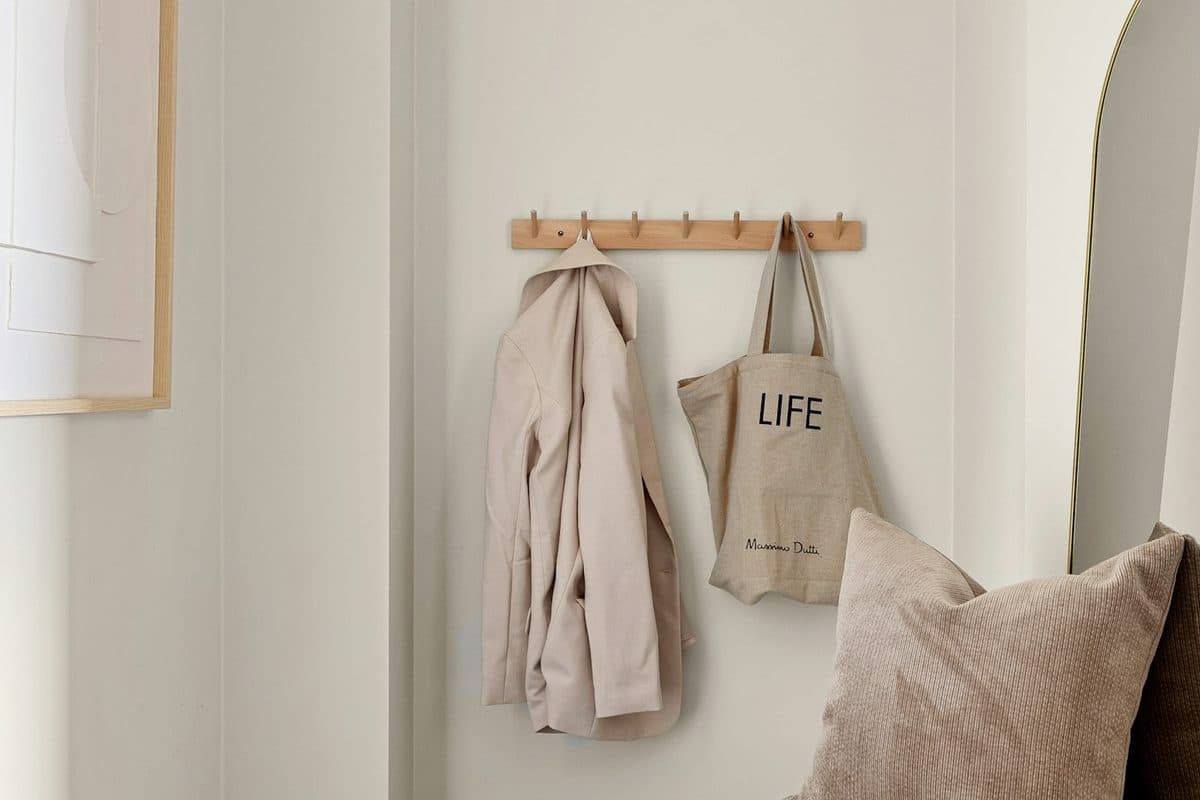
Narrow entry with a wood peg rail holding a coat and a tote, plus a woven bench. Photo via Unsplash.
Plenty of apartments do not have an entry closet. The front door opens into a short hall, or straight into the living room, and every coat, shoe, and envelope competes with the walkway.
Small entryway storage for that kind of door is a landing pattern. Keys and mail get one surface. Coats get a hook. Shoes get a limit, not a pile. Anything deeper than a shallow shelf has to prove it still lets the door open. Renters can do almost all of it with pieces that lift out or hang over the door.
🏠 Renter-friendly / no-drill — hangs, leans, or sits, with no screws.
Approx. — rough cost range in USD.
Key takeaways
Clear the floor first so the door opens and you can walk through.
Give keys and today's mail one small landing surface.
Hang coats on a door or a rail so they are not a pile.
Keep only the shoes you wear this week by the door.
Add a bench or narrow shelf only if it leaves the walkway open.
Reset mail, shoes, and bags in about two minutes when you come home.
What Does the Door Zone Have to Catch?
Stand in the doorway and list what you set down in the first minute home:
Keys, headphones, or a wallet.
Mail and a package.
A coat or a hoodie.
A bag.
The shoes that just came off.
Sometimes a wet umbrella or a leash.
Each of those needs a spot within arm's reach. If one of them has no spot, it will take the floor. The floor is the path, and the path is the whole point of an entry that is only a few feet deep.
You are not building a mudroom. You are building a checkpoint so the rest of the apartment does not inherit the sidewalk.
How Do You Store Things With No Closet?
1Step 1: Clear the floor so the door works
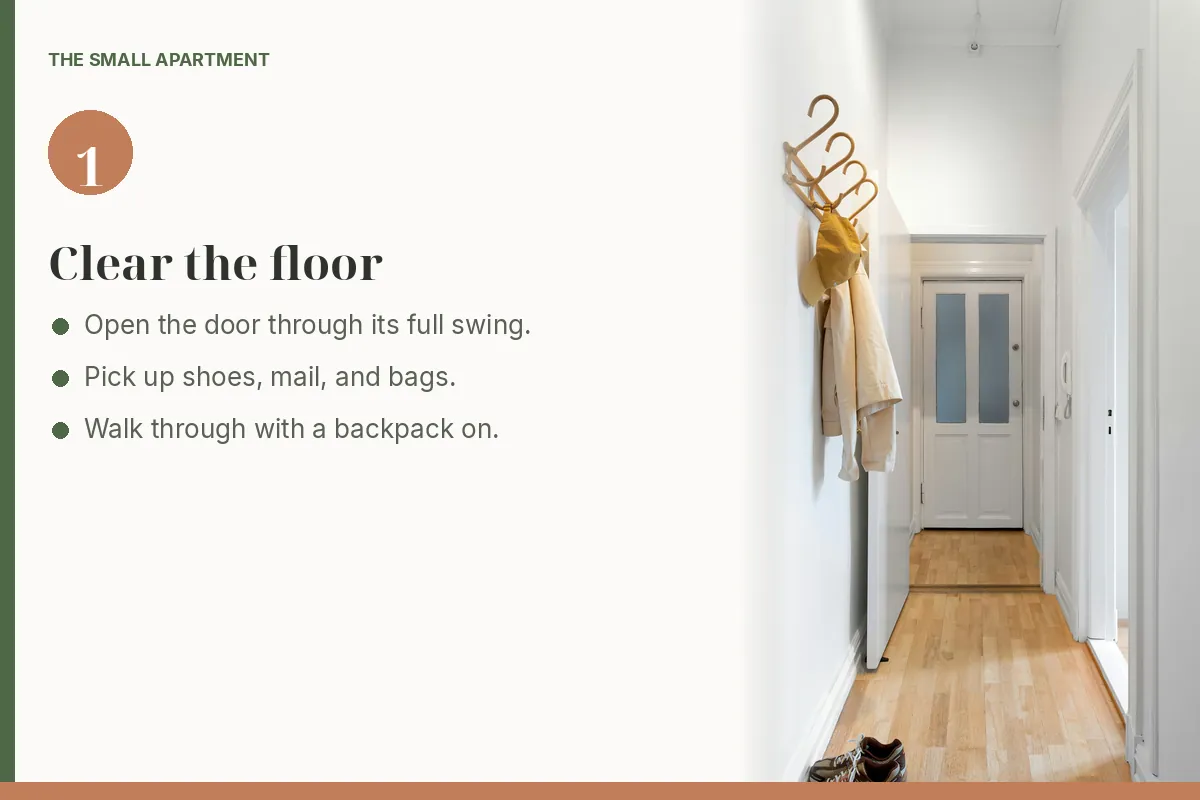
Step 1. Shoes in the walkway close a small hall.
Take everything off the floor for one afternoon. Open the door through its full swing. Walk through with a backpack on. If you have to turn sideways, the entry is already over full, and new furniture will make it worse.
Sort what you picked up:
Stays by the door: this week's shoes, the coat you wear now, the bag you carry daily.
Moves inside: dress shoes, extra jackets, sports gear, the tote you use once a month.
Leaves: packaging, lone gloves you will not match, mail you have been stepping over.
The hallway in the photo shows the usual failure: hooks are doing their job for the coat, and the sneakers are still in the path. Hooks alone are not an entry system. The floor needs a rule too.
Recycle the paper the same day. A donate bag can live in a closet for a week, not in the entry forever.
2Step 2: Make one landing spot for keys and mail
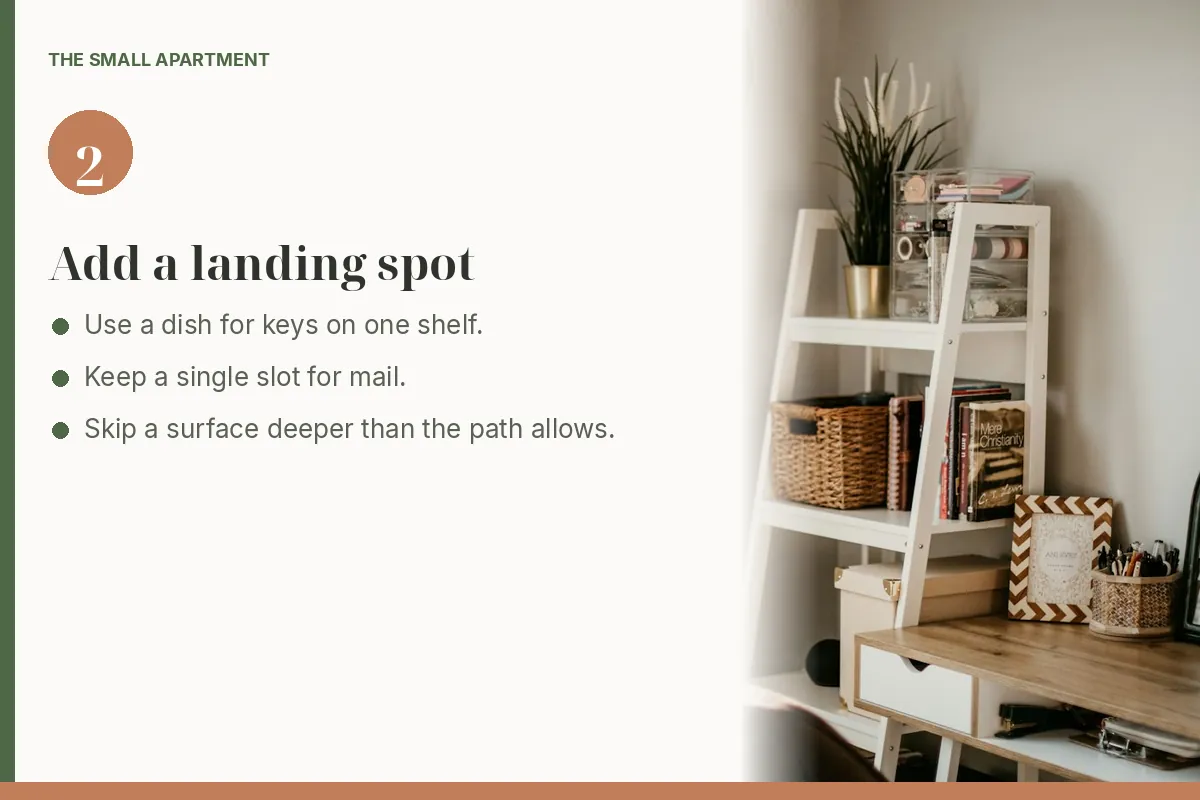
Step 2. A shelf you already have can hold a key dish and one stack of mail.
You need a surface about the size of a dinner plate, not a desk. Options that work in a rental:
A narrow console 10–12 inches deep, against a wall that is not the door swing. Approx. $20–$80 used, $40–$120 new.
A floating shelf if you are allowed a couple of screws, or a ladder shelf that leans if you are not. The shelf in the photo is doing that job in a corner: a few books, a basket, and a clear top where a dish could sit. Even a closet entry benefits from one surface outside the doors so keys are not lost inside. 🏠 A leaning shelf needs no holes; keep it stable and out of the swing.
A small dish on an existing bookcase just inside the living room, if the “entry” is only the back of the door.
On that surface:
A dish for keys.
One slot or a single upright file for mail you must keep.
Nothing else. Sunglasses can share the dish. Packages do not live there; they get opened and broken down.
Open mail over recycling. If a bill needs to stay, it goes in the slot, not in a stack that becomes a second surface.
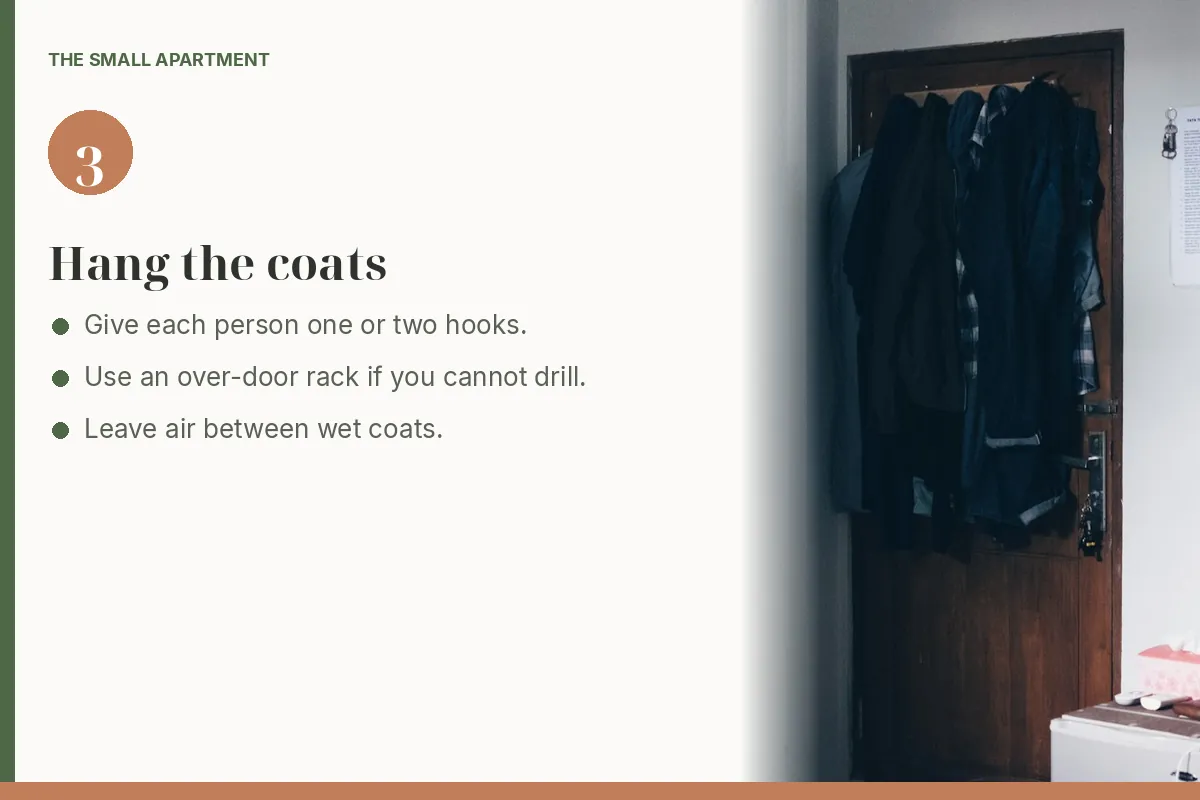
3Step 3: Hang coats so they are off the furniture
Step 3. An over-door hook keeps coats off the chair.
Coats on a chair are a sign the entry never got a hook. Give each person who lives here one or two hooks, plus one for the everyday bag.
🏠 No-drill first: an over-the-door rack on the front door or on a nearby closet door. Check that the door still latches. Felt pads on the back of the rack keep the paint quieter. Approx. $10–$25. How to measure the gap, and when to switch to a coat tree, is in over-the-door storage.
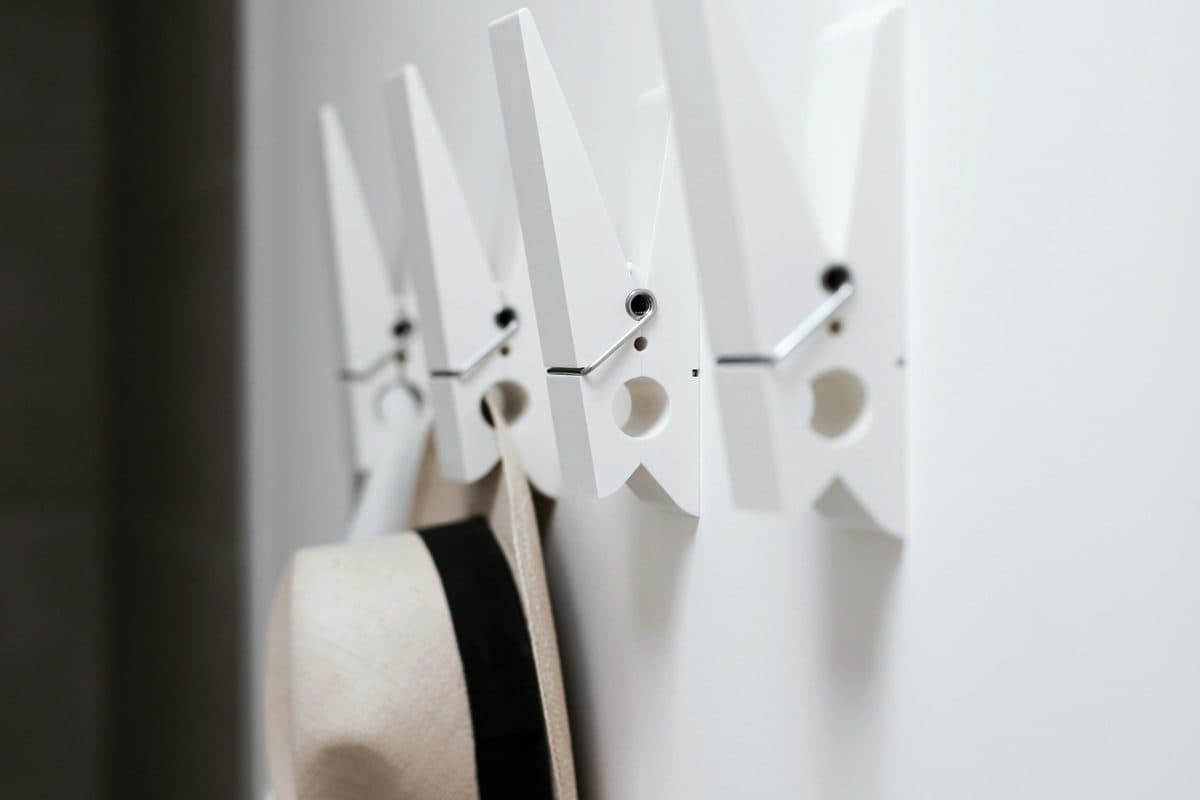
A peg rail is a clean look when you are allowed to mount it. The step photo is the no-drill version: jackets on hooks over a door. Many leases want a written yes for screws. If you are not sure, use the over-door rack until you are. Do not overload a hollow door. A coat and a tote are fine. A week of winter coats on one hook is not.
Wet coats need air. Leave a little space between them so the wall behind does not stay damp. A boot tray under the hooks catches drips better than the wood floor.
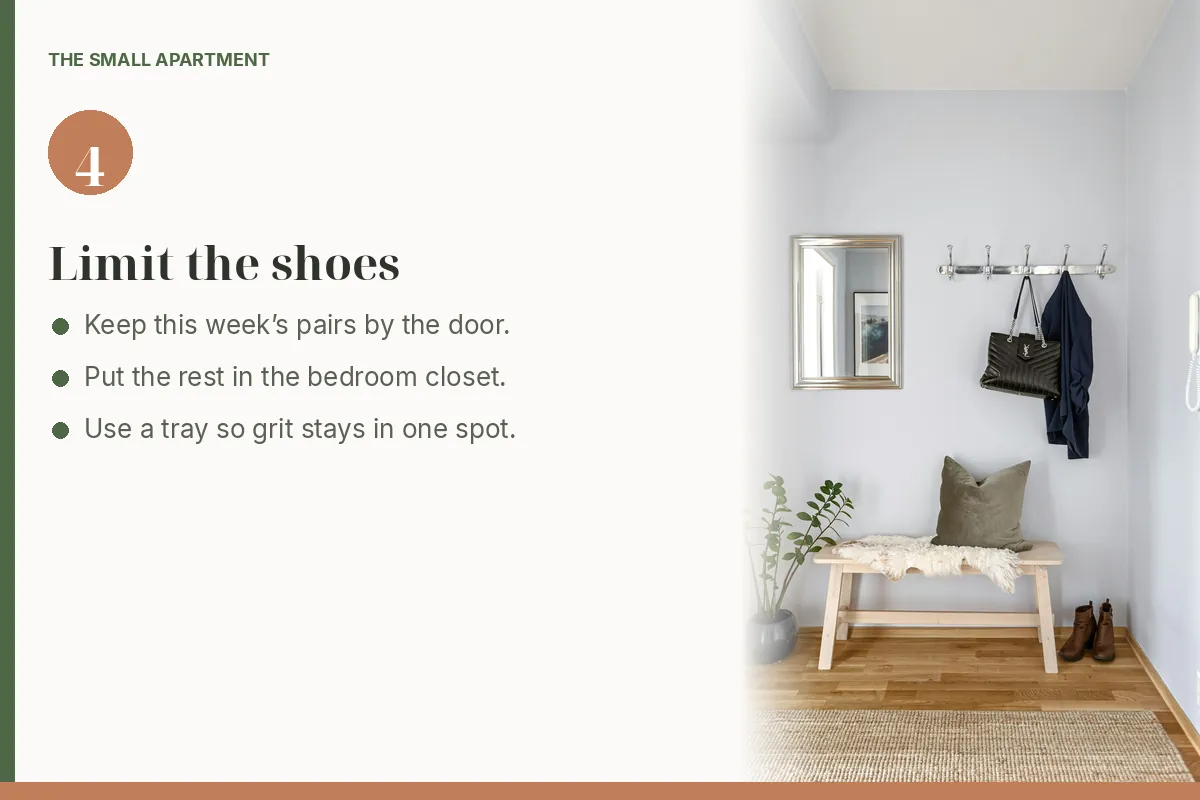
4Step 4: Limit the shoes
Step 4. One pair by the bench is a limit you can see.
The bench in the photo works because the boots are a pair, not a collection. Copy the limit, even if your bench is a tray.
This week only by the door. Rain boots can stay in the season you use them, on a tray, if they are not in the door swing.
A two-tier rack if you have the depth. Measure before you buy; many “slim” racks are deeper than a narrow hall. Approx. $15–$40.
An over-the-door shoe pocket on a bedroom or coat closet door when the entry itself has no floor to spare. 🏠 Approx. $12–$25.
A mat or tray under the shoes you do keep, so grit stays in one rectangle.
The rest of the shoes go to the bedroom closet. That closet has its own floor plan in small closet organization. The entry is a checkpoint, not a second wardrobe.
Guests can use the same tray for the evening. You do not need a shoe cabinet for a dinner.
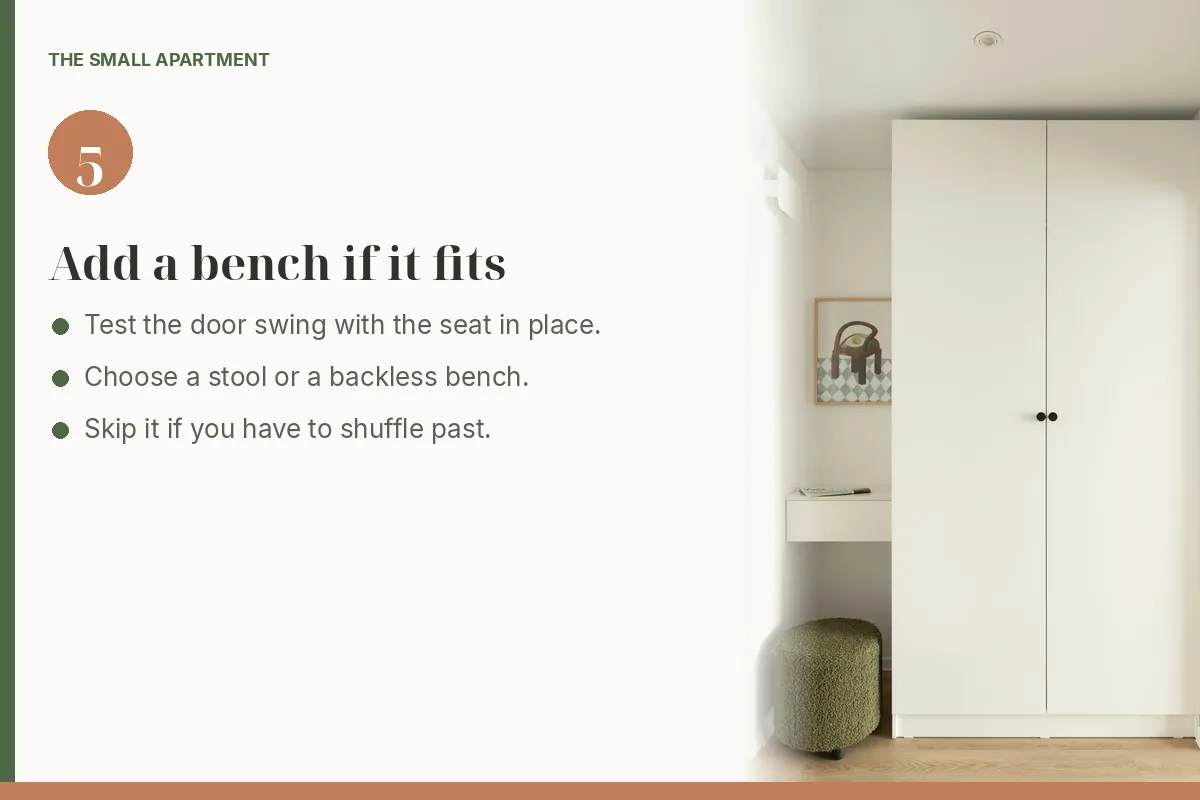
5Step 5: Add a bench only if the path survives
Step 5. A small stool can sit beside storage without filling the hall.
A bench is worth it when you sit to put shoes on and you still have a path. It is not worth it when the door hits it.
Use this test:
Open the door all the way.
Walk past with a grocery bag in each hand.
Sit, if the bench is for sitting. Your knees should not be in the swing.
A backless bench, a storage ottoman just outside the swing, or a stool like the one beside the shelf in the photo is usually the right scale. A deep hall tree with a mirror, a cabinet, and a bench is a mudroom piece. In a three-foot hall it becomes the obstacle.
Approx. $25–$80 for a simple bench or stool, less if you find one secondhand. 🏠 Freestanding pieces leave when you do.
If there is no floor at all, skip the bench. The hook and the dish are the whole system, and that is enough.
6Step 6: Reset the entry in two minutes
Step 6. A two-minute reset keeps the landing spot from becoming a pile.
Do this when you walk in, not on a future Sunday:
Coat and bag on their hooks.
Shoes on the tray, extras carried to the closet if you wore a spare pair home.
Mail opened over recycling, or stood in the one slot.
Keys in the dish.
Package broken down or moved to where it will be unpacked tonight.
Once a week, look at the hooks. If a jacket has not moved in the season, it does not need a prime hook. The weekly pass in small apartment organization already includes the entry; this two-minute version is the daily slice.
Which Pieces Fit, and Which Do Not?
Piece
Fits a no-closet entry
Watch out
Over-door hooks 🏠
Coats and one bag
Door must still latch; hollow doors hate heavy loads
Key dish on a shelf
Keys and outgoing mail
Do not let it become a junk bowl
Slim shoe rack or tray
This week's shoes
Measure depth before you buy
Leaning ladder shelf 🏠
Mail, a plant, a dish
Must be stable and out of the swing
Backless bench
Sitting, if the path remains
Skip if the door hits it
Full hall tree
Rarely, only in a wide foyer
Too deep for most apartment halls
Second shoe cabinet
Almost never by the door
Use the bedroom closet instead
Budget: hooks, a dish you already own, and a tray can be under $20. A bench or a narrow console is the optional next piece, not the start.
What If the Entry Is the Living Room?
Some doors open onto the sofa. Treat the first three feet inside as the entry anyway.
Hooks on the door itself, or on the wall beside it if mounting is allowed.
A tray for shoes aimed along the wall, not in front of the sofa.
The key dish on the nearest side table, and that side table is not also the mail archive.
Then protect the rest of the room with the walkway rules in small living room layout. The entry should not leak shoes onto the rug.
Shared apartments need labeled hooks more than they need matching baskets. One hook per person, one shared hook for guests, and a tray that is allowed to hold only a set number of pairs.
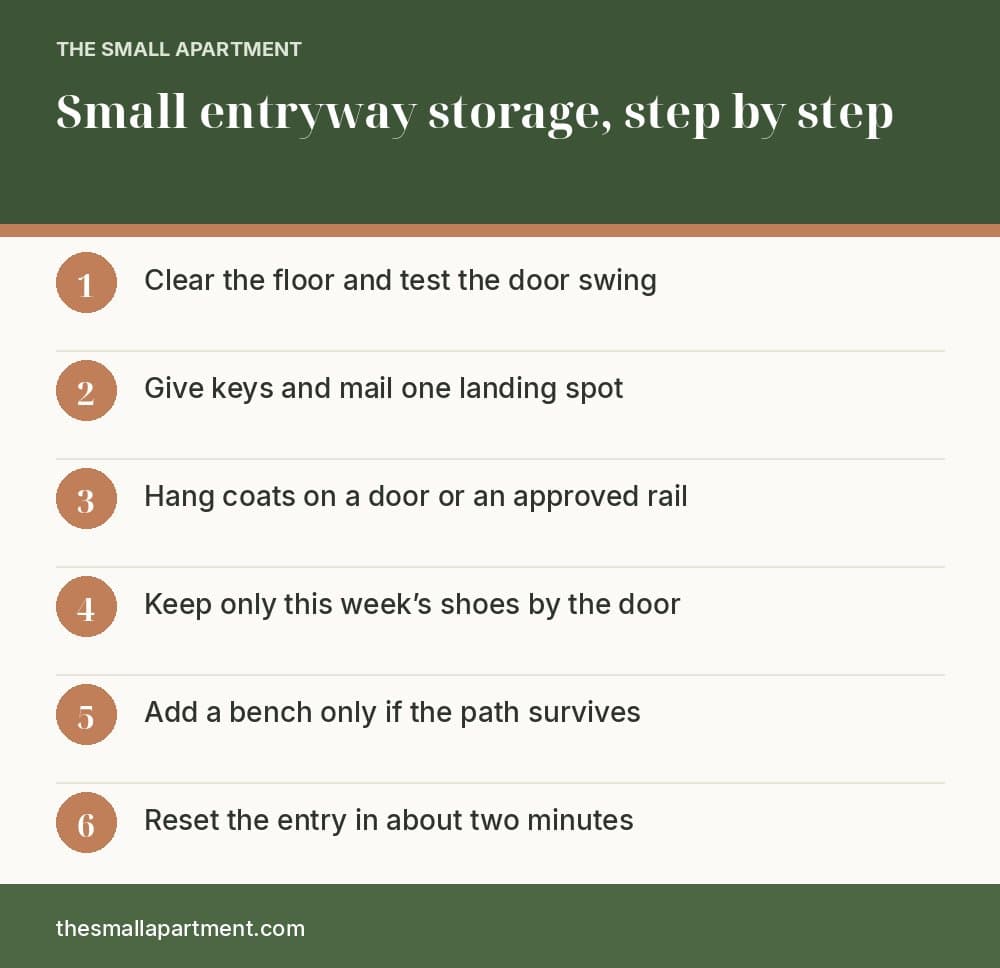
All-steps checklist for small entryway storage without a closet.
How Do You Keep the Floor by the Door Clear?
You do not need a closet to have an entry. You need a hook, a dish, a shoe limit, and the habit of using them before the coat hits a chair. Measure the swing, keep every piece shallow, and let the bedroom closet hold the rest.
Use the door, a few inches of wall, and one shallow surface. An over-the-door hook rack holds coats and a bag. A narrow shelf, a small table, or a wall-mounted rail with a dish holds keys and mail. A shoe tray or a two-tier rack holds this week's shoes. Skip anything deeper than about 10 to 12 inches if the entry is a hallway.
What can renters use if they cannot drill?
Over-the-door hooks, a leaning ladder shelf, a freestanding narrow console, and a boot tray need no holes. Removable adhesive hooks can hold a light leash or a hat if you test the paint first. A peg rail that needs screws should wait for written permission.
How many shoes should stay by the door?
Keep the pairs you wear in a typical week, often two to four pairs per person, and store the rest in the bedroom closet. One family rule that works is: if it is wet or worn today, it can be by the door; if not, it has a home farther inside.
How do I handle mail in a tiny entry?
Open it over the recycling bin the day it arrives. Keep a single upright sorter or a wall pocket for bills you must keep, and do not let catalogs stack on the floor. A small tray is for keys and outgoing mail, not for a month of paper.
Is a bench a good idea in a narrow entry?
Only if you can still open the door and walk past with a bag. A backless bench or a stool about 10 to 12 inches deep can work. If your entry is a corner of the living room, a storage ottoman just inside, out of the door swing, is often better than a bench in the swing itself.
How do I keep a no-closet entry from getting cluttered again?
Do a two-minute reset when you walk in: coat on the hook, shoes on the tray, mail opened or in the sorter, bag on its hook. Once a week, move extra shoes and the donate pile out of the entry.
Get the small apartment checklist
One short email a week with a small-space fix that actually works in a rental. You also get our printable room-by-room checklist. No spam, unsubscribe anytime.