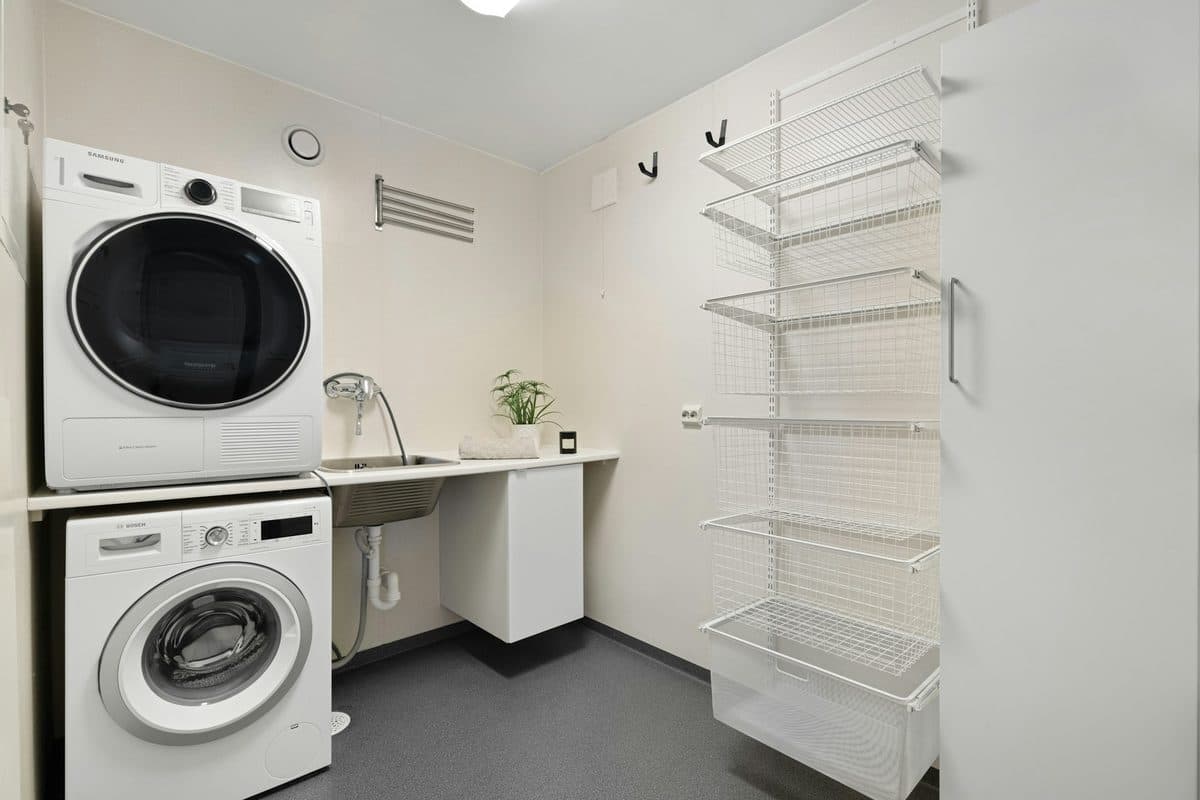
Stacked white washer and dryer beside a narrow sink, with a tall wire shelf on the opposite wall and the edge of a door at the right. Photo via Unsplash.
A tiny laundry closet is a box with a door, not an open corner. The machines have to fit, the door has to close, and the strip of floor beside them has to stay honest about how wide it is.
Organize the closet in this order: measure the opening and the door swing, choose a stack or a side-by-side pair from that width, give the gap beside the machines one narrow job or no job, and keep door-back hooks slim enough to clear the dryer. Detergent, the hamper, and the reset after a load are already covered in small laundry room organization. This page is the closet itself.
Clothes closets that are not hiding a washer use a different plan, in small closet organization. Hooks that hang over a door, and the doors that cannot take them, are in over-the-door storage.
The cover photo is a laundry room, not a reach-in closet. Copy the stack, the narrow counter beside it, and the door at the right edge. Ignore the rest of the floor.
Key takeaways
Measure the opening, the depth, and the path of the open door before you buy a shelf or a bin.
Stack the machines when the closet is about one machine wide. Use side by side only when two machines and the door still clear.
The gap beside a stack fits a narrow bin, or it fits nothing. It is not a second closet.
Door-back storage has to be slim enough that the door latches without hitting the machine.
The floor holds the basket you are using, or the basket lives outside the closet.
Supplies, the hamper home, and folding after a load are covered in the laundry nook guide.
How Do You Measure a Laundry Closet Before You Buy Anything?
1Step 1: Measure the opening and the door swing
Step 1. A tape on a table, not in a closet. Use one the same way on the opening, the depth, and the floor where the door travels.
The photo is a tape measure on a white surface. The closet version is three numbers, written down:
Width of the opening, in the narrowest spot, including the door frame.
Depth, from the back wall to the inside of the closed door.
The swing. Open the door all the way and see what it crosses. A bifold folds into the room. A slider needs a clear track. A hinged door needs an empty arc.
Then open the washer door and the dryer door, if you can, and see whether they hit the closet door or the side wall. A machine that only opens when the closet door is pinned back is a closet you will stop using.
Read the width on the spec sheet for the machines you already have, or the ones you are allowed to install. Do not guess from a photo of someone else's stack.
Should the Machines Be Stacked or Side by Side?
2Step 2: Match the pair to the width you measured
Step 2. A stack in a tight kitchen. A closet puts a door in front of the same tall, one-machine-wide shape.
The photo shows a stacked washer and dryer in a narrow kitchen, with cabinets tight beside them. That is the stacked footprint: one machine wide and tall. It is not a closet, and it is not a bifold door. The shape is what transfers. The cover photo is the one with a real gap and a door edge.
Use the numbers from step 1:
One machine wide, with the dryer's overhead clearance. Stack them. Side by side will not fit, and forcing it means a door that stays open.
Two machines wide, plus the side clearance the manual asks for, and the door still closes. Side by side is the lower, wider plan. You gain a top surface and lose floor.
Not sure. Stay stacked if a stack is what you have. Moving a pair is a plumbing job, not a bin job.
Leave the top of the dryer clear when the manual says that surface needs air. A folded towel you are holding is different from a basket that lives there. The shelf and rod above an open laundry nook, which is a different wall, are in the laundry nook guide.
What Fits in the Gap Beside the Machines?
3Step 3: Give the gap one narrow job
Step 3. Bins beside a stack, in a room with floor to spare. In a closet, only the bins that stay put when the door closes belong there.
The photo is a stacked pair with white bins in the space beside them and cabinets overhead. The room is bigger than a closet. The useful part is the gap: it is a column, not a second room.
Stand in the gap. If your shoulders fit, you can keep a slim shelf there for detergent, as the nook guide describes. If only a hand fits, the choices are a narrow bin or nothing.
Skip these in that gap:
A second hamper. It becomes the thing you climb over.
Spare jugs lined up on the floor. They block the washer door and they leak toward the outlet.
A drying rack stored upright. It falls into the swing.
Anything you must drag out before the machine door opens.
A bifold that needs that floor for its fold is the same rule. The track and the fold win. The bin moves.
What Can Go on the Back of the Door?
4Step 4: Keep door-back storage slim
Step 4. Several jackets on one bedroom door. A laundry closet door usually has room for less, because it has to pass the dryer.
The photo shows several jackets on hooks over a wooden door. That door is doing a lot. A laundry closet door usually cannot. The dryer is right behind it, and the door has to reach the latch.
What usually works:
One over-the-door hook for a lint brush or a single empty hanger.
Nothing that sticks out farther than the clearance you measured in step 1.
Nothing on a sliding door's track, and nothing on a bifold panel that has to fold flat.
Close the door with the hook loaded. If it bounces open, or if it taps the machine, take the hook off. A pocket organizer full of bottles is the usual failure. The full door-hook rules, including doors that should stay bare, are in over-the-door storage.
Do not drill the door the landlord owns. An over-door hook that hangs on the top edge comes off when you move.
Where Does the Hamper Go?
5Step 5: Keep the floor clear enough for the door
Step 5. Three baskets beside a bed, which is more floor than a closet has. One basket, and only if the door closes.
The photo is three baskets on a bedroom floor. A laundry closet does not have that floor. One basket is the maximum, and only in a spot you marked while the door was open.
If the basket stops the door, it lives just outside the closet. You carry it in on wash day. That is a better trade than a door that never latches and a machine you cannot reach.
The hamper's home, detergent up off the floor, and folding so the basket does not become a dresser are the point of small laundry room organization. Use that page for the supplies. Use this one so the door still shuts after you follow it.
How Do You Finish a Load So the Door Closes?
6Step 6: Put it back before the next load
Step 6. Rolled textiles on shop shelves. In the closet, the same idea is one shelf of finished laundry, not a pile in the door swing.
The photo is a shop wall of rolled textiles. Your closet will not look like that. The transfer is simple: finished laundry goes to a shelf, a rod, or a drawer, not onto the floor in front of the machines.
Before you shut the door:
Pull the load out. Do not start another one on top of a full drum just to hide it.
Move the basket back to its spot, inside or outside.
Caps back on the detergent. The jug does not live on the floor in the gap.
Close the machine doors, then the closet door. If the closet door will not latch, something from this list is still in the swing.
A tension rod for a few shirts belongs in this closet only when the span is short, both ends sit flat, and shirts will not fall into the control panel. A rod with no weight rating is a light-duty rod. The limits are in tension rod hacks for renters.
All six steps for a laundry closet: the opening, the pair, the gap, the door, the floor, and the reset.
What to Do When the Closet Is the Whole Laundry Room
Treat the door as part of the appliance. If it does not close, the closet is not organized yet, no matter how many bins you bought. The supplies and the folding habit live in the laundry nook guide. The door, the gap, and the stack live here.
Printable Tiny Laundry Closet Checklist
Frequently asked questions
How do you organize a tiny laundry closet?
Measure the width, the depth, and the door swing. Put in a stacked pair if the opening is about one machine wide, or side-by-side machines if you truly have two widths and the door still closes. Use the gap beside the machines for one narrow bin or leave it empty. Keep door-back hooks slim, and keep the floor clear enough for the door to shut.
Should apartment laundry machines be stacked or side by side?
Stack them when the closet is only wide enough for one machine. Put them side by side when the opening fits two machines plus the clearance in the manual, and the door still closes. Read the width on the spec sheet for the machines you have. A stack also needs the overhead clearance the dryer manual asks for.
What can go in the gap beside a stacked washer and dryer?
A narrow bin, a slim shelf, or nothing. If you have to pull the bin out to open the washer door, the bin is in the way. Do not store spare detergent jugs, a second hamper, or a drying rack in a gap you cannot walk past.
Can you hang storage on a laundry closet door?
Yes, if the door still closes and the hooks do not hit the machine. One hook for a lint brush or an empty hanger is the usual fit. A full coat load or a deep pocket organizer often hits the dryer or keeps the door from latching. Test with the door shut before you load the hooks. Sliding and bifold doors need a clear track, not a basket in the way.
Where does the hamper go in a laundry closet?
Inside, only if the door closes with the hamper in its spot. Otherwise the hamper lives just outside and you carry it in on wash day. The laundry nook guide covers the hamper home, detergent off the floor, and the shelf above the machine.
What is the difference between a laundry closet and a laundry nook?
A nook is the open corner: hamper, detergent, and the wall above the machine. A closet is a box with a door. The door swing, the gap beside a stack or a side-by-side pair, and storage on the back of that door are the extra problems. Use both guides if you have machines behind a door.
Get the small apartment checklist
One short email a week with a small-space fix that actually works in a rental. You also get our printable room-by-room checklist. No spam, unsubscribe anytime.