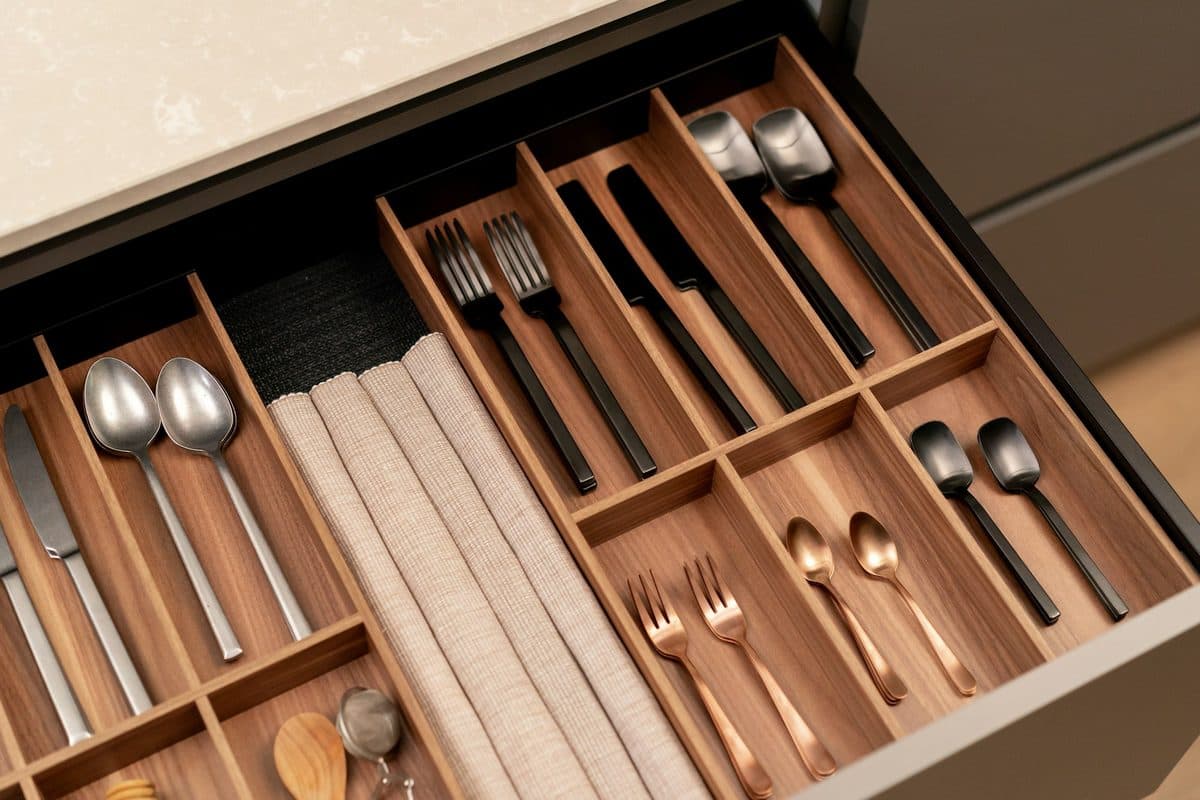
An open kitchen drawer with a rigid wood cutlery insert holding spoons, forks, knives, and rolled napkins in separate compartments. Photo via Unsplash.
A dollar-store organizer is a shape. The question is whether that shape has to hold still, hold weight, or survive water. Those are three different buys, and the cheap one is the right one for the first.
Use a dollar-store organizer for mail, pens, packets, clips, labels, and any divider that stays square while it sits. Pay more when the piece carries plates, a closet of clothes, a hamper you walk to the laundry, or bottles in a damp cabinet. The test takes ten seconds in the aisle. Press the side. If it oil-cans under your thumb, it is light duty.
Prices below are published ranges and one product page, not a guess at what a mid-range brand charges. A stiffer bin costs more than the dollar-store version of the same shape. Read that tag too.
Key takeaways
Cheap is the right buy for light, dry, still things. Mail trays, pen cups, and open bins of packets qualify.
Pay more for a rigid wall when the bin holds plates, a full closet of clothes, or bottles under a sink.
Press the plastic. A side that oil-cans under your thumb is light duty, even if the label looks sturdy.
A fabric bin you lift needs a stiff base and handles that are stitched, not glued on.
Thin wire flexes and snags knits. Cardboard softens in a damp cabinet. Suction is a weak hold on a wet wall.
Buy one of a matching set, load it for a week, then buy the row.
Which Organizers Are Fine Cheap?
1Step 1: Press the plastic before you trust the label
Step 1. This is a work van, not a kitchen. Copy the flex test and the readable labels, not the van.
The clear bins in the photo are in a work van, labeled with tape. They are not a pantry. The useful part is the plastic you can press, and a label you can read from the door.
In the store, do this with the bin in your hand:
Press the long side with a thumb. A gentle flex that springs back is normal. A side that oil-cans, with a pop, is light duty.
Look at the hinge on a lidded box. It should be about as thick as the wall. A cloudy thin line at the hinge is the part that splits.
Set it on a flat edge. A rocking base rocks in a drawer and walks forward every time you open it.
Ignore "heavy duty" printed on a thin box. The thickness is the rating. Clear is not stronger than white.
Fair cheap jobs, if it passes that press: a mail tray, a pen cup, a sock divider that stays square, an open bin of packets, binder clips, and a label you stick on the front. The pantry version of that label is in pantry labels.
When Should You Pay More Than a Dollar Store?
2Step 2: Plates and full bins need a rigid wall
Step 2. The gray dividers are holding stacks of plates and cups. A flexing tray is the wrong tool for that drawer.
The drawer in the photo has rigid gray organizers and real stacks: plates, bowls, cups. The dividers are doing a weight job. A thin dollar-store tray can sort packets in a pantry. It bows under a stack of plates, and then the stack leans into the drawer front.
Pay more, meaning a bin with a wall you cannot oil-can, when:
The load is dishes, cans, or a closet bin you fill with clothes.
You lift it. A hamper you carry to the laundry is a handle test, not a sitting test.
It lives under the sink, where a leak is normal. Cardboard and raw particle board soften there. The layout for that cabinet is in under-sink organization.
You open it every day and the hinge is the cheap part.
A mid-range organizer is not a brand name. It is the one that matches the drawer width, stands without rocking, and does not fold when you pick it up full. Measure the drawer before you go. A bin that is 1 inch (2.5 cm) too wide becomes a different problem, and no thickness fixes it.
How Do You Judge a Fabric Bin?
3Step 3: A stiff base and handles you can lift
Step 3. The basket is being lifted, and it is keeping its shape. That is the test, not the weave.
Hands in the photo are sliding a woven basket of spray bottles onto a shelf. A second basket sits above it. The basket holds a rectangle while it moves. That is the difference.
A fabric bin that only sits can be the cheap one. Folded shirts on a closet shelf do not care about a handle. The moment you lift it, look for two things:
A base that stays flat. Cardboard inserts that are flimsy fold in the middle and dump the corner.
Handles sewn through the fabric. A handle glued to the rim lets go when the bin is full.
If the closet system is hangers and a second rod, you may not need the bin at all. That setup is in small closet organization.
What Fails First?
4Step 4: Wire, damp, and the part that moves
Step 4. These wire shelves are outdoors and empty. The test is whether the grid flexes in your hands, not where they are sitting.
The white wire in the photo is a pile of empty shelves outdoors. They are not in a closet. Pick one up. If the grid twists, it will twist on a shelf, and knits will catch on the cut ends.
What to check, in the order it usually shows up. This is a checklist, not a failure rate:
Part
What you should see
Cheap version fails by
Plastic wall
A thumb press that springs back
Oil-canning, then a crack at the corner you keep flexing
Hinge
About as thick as the wall
A split along the thin line
Wire grid
Stays square when you twist it
A bend, then snags on knits
Fabric base
Stays flat when lifted
Folds, and the contents slide
Cardboard
Dry shelf only
Softens under a sink
Suction cup
A dry, smooth, flat surface
Lets go on a damp or textured wall
None of those has a number of months attached. A thin hinge can last if you never flex it. A thick one still fails if you overload it. The check is the part, in your hand, before you buy eight.
Should You Buy the Matching Row?
5Step 5: One bin, one week, then the set
Step 5. A shop wall of identical boxes. It looks finished. Buy one and load it before you copy the wall.
The photo is a retail wall of matching white boxes, with a gray basket on one shelf. The labels are printed on the boxes. It looks like a system because every box is the same. That is the trap. If the first box flexes, the whole wall flexes.
Buy one. Put the real thing in it: the mail, the packets, the socks, the bottles. Use it for a week. Close the drawer. Lift it if you will lift it. Then buy the row, or put it back.
A matching set that is the wrong thickness costs more than one good bin and a few cheap trays for the light stuff. Mix them. The plates get the rigid divider. The tea packets get the dollar-store bin.
Budget: one cheap piece per light job, and one stiffer piece for the heaviest job in the room. On 22 October 2026 Dollar Tree listed a 13 by 9.5 inch Jot file organizer at $1.25, and said the price may vary by location. Dollarama's Canadian merchandise range in its 2026 annual information form is $0.25 to up to $5.00. That form covers the fiscal year ended 1 February 2026, in Canadian dollars. It is not a promise that your drawer insert is at the bottom of the range.
All-steps checklist for cheap versus stiffer organizers.
What Should the Drawer Look Like After You Choose?
Light things in the thin bin. Heavy things in the bin you could not flex. One of each is a finished drawer. A row of matching boxes you have not tested is a guess.
Are dollar-store organizers good enough for a small apartment?
Yes, for light, dry, still storage. A mail tray, a pen cup, a sock divider that stays square, an open bin of packets, clips, and labels are fair dollar-store jobs. They are a poor buy when the organizer has to carry weight, sit in water, or get yanked every day. That is a plate stack, a closet bin full of clothes, a hamper you carry to the laundry, and bottles under a sink.
How do you judge plastic organizer quality in the store?
Press the long side with your thumb. If it oil-cans and pops back, treat it as light duty. Look at the hinge. It should be as thick as the wall, not a thin film. Stand it on a flat shelf edge. A base that rocks will rock in the drawer. Clear plastic is not stronger than opaque plastic. The thickness is the tell.
When is a fabric bin worth more than a cheap one?
When you pick it up full. A cheap fabric cube can hold folded shirts while it sits on a shelf. The version worth more has a stiff base that does not fold in half, and handles sewn through the fabric rather than glued to the rim. If you only slide it, the cheap one is fine until the base sags.
What fails first on a cheap organizer?
Check the part that moves or gets wet. A thin hinge splits. A wall you keep flexing cracks at the corner. Thin wire bends and then snags knits. Cardboard under a sink softens. A suction cup on a damp wall lets go. None of these is a timer. They are the spots to look at before you buy a stack.
How much do dollar-store organizers cost?
Read the ticket, because the chains are not one price. On 22 October 2026, Dollar Tree listed Jot plastic and nylon file folders with snap closures, 13 by 9.5 inches, at $1.25 each, and the page says price, availability, and selection may vary by location. Dollarama's 2026 annual information form, for the fiscal year ended 1 February 2026, says Canadian merchandise prices range from $0.25 to up to $5.00. That is the store range in Canadian dollars, not the price of a drawer insert. The same form says Australian merchandise sold between A$0.45 and A$15.00 made up over 90 percent of sales from 21 July 2025 to 1 February 2026. That is a sales mix, not one bin. UK discount shops do not share one published list. Read the tag.
Should you buy a whole matching set at once?
No. Buy one, put your real stuff in it, and use it for a week. If the wall flexes, the handle tears, or the drawer will not close, that set is the wrong set. A wall of identical boxes looks finished and fails together.
Get the small apartment checklist
One short email a week with a small-space fix that actually works in a rental. You also get our printable room-by-room checklist. No spam, unsubscribe anytime.