A brown leather sofa with a canvas mail bin on the floor beside the seat. Photo via Unsplash.
A studio has one room and a lot of jobs. The furniture has to share them. Buying a matching set is how the path disappears.
Studio apartment organization tips for furniture come down to order. Buy the piece that replaces two single-job items you already trip over. In most studios that piece is the bed, because you use it every night. A sofa bed is a later decision, not the first one.
The full room plan, including zones and a short daily reset, is in studio apartment organization. Where the seat faces, and how wide the walkway stays, is in small living room layout. This guide is only the buying order.
The cover photo is a leather sofa with a canvas bin beside it. Seat, plus a place for the mail. That is the test for every piece below. If it only does one job, it has to be small, or it has to go.
Key takeaways
Buy in this order: bed storage, one storing seat, a small table, one shelf.
A bed you sleep in every night beats a sofa bed you convert twice a year.
One seat can be an ottoman with a lid, or a chair plus a bin. Not both a sofa and an armchair.
A table only needs to seat the people who actually eat there.
Open shelves are for a few objects. Closed bins are the storage.
Stop when the path from the door to the bed is still clear.
Which Piece Do You Buy First?
Use this order. Skip a step only if you already own a piece that passes the test.
Bed storage. Drawers in the frame, or bins under the bed you have. This is first because the bed is already in the room every night.
One seat that stores. A storage ottoman, a bench with a lid, or the sofa you own plus one bin. Not a sofa and an armchair.
A table sized to the people who eat there. Two chairs, or a drop-leaf you keep folded. Not a dining set from a larger apartment.
One shelf that holds closed bins. It can also divide the bed from the seat. Open shelves stay mostly empty.
Stop. A second cabinet, a second bulky chair, or a desk that duplicates the table is how the studio fills up.
The catalog of pieces that can do two jobs, and the ones to skip, is already in the studio guide. This list is the sequence, so you do not buy all of them in one weekend.
How Do You Choose Studio Furniture?
1Step 1: Name the one-job piece in the way
Step 1. A sofa and an empty wall. The seat is doing one job. The next buy should store something.
The photo is a green velvet sofa, an empty wall, and a wood floor. There is no bin, no shelf, and no table. As a picture it is calm. As a studio it is a seat that only seats.
Walk the room and point at the largest thing that does not store, fold, or divide the space. That is the piece the next purchase has to beat. Often it is:
A sofa with no storage, and a pile of blankets on the floor beside it.
A bed frame so low that nothing fits underneath.
A table you walk around every time you reach the kitchen.
A chair nobody sits in, parked in the path.
Do not buy a new category of furniture to hide that piece. Either the next item replaces it, or it stores what is currently on the floor around it. Small bedroom organization covers the bed itself if the mattress is the thing eating the room.
2Step 2: Put storage under the bed first
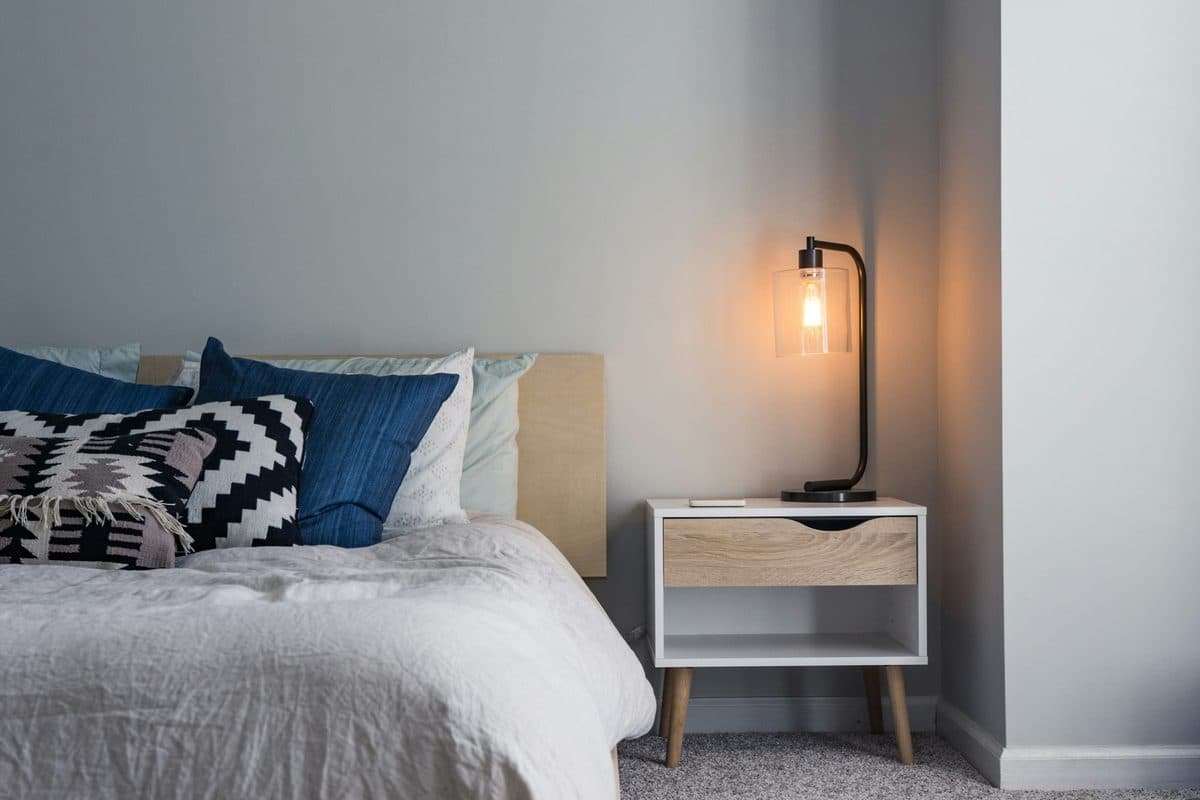
Step 2. This bedroom is larger than a studio. The useful part is the bed, with storage in reach, not the pillow count.
The photo is a staged bedroom: a tufted bed, a bench at the foot, nightstands, more pillows than a studio needs. It is a bigger room than yours. Do not copy the furniture count. Copy the idea that the bed is the storage, and the things you use at night are within reach.
Buy in this order inside the sleeping spot:
Bins that slide under the bed you already own, if a hand can reach them without lifting the mattress.
A frame with drawers, if you are replacing the bed anyway.
A sofa bed only if you will fold it every morning and you have measured the open size. The open bed still needs a path to the bathroom.
Nightstand cabinets can hold a book and a charger. They are not a closet. Off-season clothes belong in the bins under the bed, or in the closet guide, not in a second dresser that blocks the window.
Measure the open path before the bed moves. The living room layout rule applies here too: you should walk from the door to the bed without turning sideways.
3Step 3: Add one seat that stores
Step 3. A chair and an ottoman in a library. A lid on the ottoman is the storage version. You do not also need the bookshelves and a sofa.
The photo is a green chair and a matching ottoman in a library, with a small round table and shelves of books. The ottoman in the picture is not a storage ottoman. A lid is what makes that shape useful in a studio. Blankets, a spare sheet, or the game you drag out when someone visits go inside. The chair stays a chair.
Pick one:
A storage ottoman or a bench with a hinged lid, if you already have a sofa.
A sofa, if you have no seat yet, plus one bin beside it like the cover photo.
Two small chairs, if two people live there and a sofa will not fit the path.
Skip the second bulky chair. A studio that seats four people who do not live there is a studio you cannot walk through on a Tuesday.
4Step 4: Choose a table that fits the kitchen
Step 4. A round table and two chairs, with the kitchen in the same room. That is a studio-sized table.
The photo is a round wood table, two chairs, and a kitchen a few steps away. Two seats. A clear walk around the table. That is the scale to copy.
A drop-leaf or a gateleg stays folded against the wall on ordinary nights.
A round table needs less clearance than a rectangle, because you are not dodging four corners.
Two chairs are enough for two people. Extra chairs can live under the table, or not exist.
The table should not sit in the path from the door to the bed, or in the swing of the oven and the fridge.
If you eat on the sofa five nights a week, do not buy a four-top to fix a habit you like. A small table for the laptop and a plate is the piece. The larger table is for a different apartment.
5Step 5: Add one shelf, and close the bins
Step 5. The open shelves are full of objects. The storage is the row of closed bins underneath. Copy the bins.
The photo is a bright room of white shelves: books, plants, toys, and a clock on the open shelves, with a row of white bins in the cubbies below. Some bins are labeled. It is a playroom, not a studio living zone. The open half is a display. The closed half is storage.
In a studio, flip the ratio. A few objects on the open shelf. Everything else in a bin with a lid or a solid front, label facing out.
A shelf can also stand in the room and mark the bed off from the seat. It only works if you can still walk both sides, and if the back of the shelf is not a second junk surface. One shelf. Not a wall of them.
6Step 6: Stop at one cabinet
Step 6. One sideboard and one chair. The next cabinet is the one that blocks the path.
The photo is a sideboard with marble-look doors, one chair, the edge of a round table, and a rug. One cabinet. That is the stopping line.
A cabinet earns its place if it holds what used to live on the floor: a router, board games, extra linens, the bin from beside the sofa. It does not earn a twin. A second low cabinet plus the first one is a wall you have to walk around.
Before you click buy, stand in the doorway and trace the path to the bed, the bathroom, and the fridge. If the new piece crosses that path, it is the wrong size, even if it stores a lot. Studio apartment organization has the zone map if the room still feels like one pile after the furniture is in.
What to Buy, and What Can Wait
Buy when
Piece
It replaces
First
Bins under the bed, or a storage bed
A dresser that blocks the path, and the pile under the frame
Second
Storage ottoman, or a sofa plus one bin
A chair nobody sits in, plus blankets on the floor
Third
Round table for two, or a drop-leaf
A dining set, or eating on the floor
Fourth
One shelf with closed bins
Open clutter used as a room divider
Later, or never
Sofa bed
Only if you will fold it every day
Skip
Second bulky chair, second cabinet, entertainment center
Nothing. They take the path
All-steps checklist for what to buy first in a studio.
What Does Finished Look Like?
You are done when the bed stores something, one seat stores something, the table fits the people who eat there, and you can still cross the room. The next piece can wait until something you own stops earning its floor space.
What furniture should I buy first for a studio apartment?
Start with storage under the bed, either a bed with drawers or bins under the bed you already own. You use that spot every night. A sofa bed, a second chair, and a large table can wait until the bed is doing two jobs.
Is a sofa bed or a real bed better in a studio?
A real bed with storage underneath is the better first buy if you sleep there every night. A sofa bed is worth it when you truly need the sleeping area to disappear during the day and you will fold it daily. Many people do not.
What is one piece of furniture that does two jobs?
An ottoman with a lid is a seat and a bin. A drop-leaf table is a small table on weeknights and a larger one when someone comes over. A bookcase placed in the room can divide sleep from sitting and hold closed bins.
How many seats does a studio need?
Enough for the people who live there, plus one spot a guest can use. That is often one sofa or a daybed, or two small chairs. A second bulky armchair is the piece that usually blocks the path.
Where should a table go in a studio?
Next to the kitchen, out of the path from the door to the bed. A round table with two chairs needs less clearance than a rectangle with chairs on every side. If you eat on the sofa most nights, a drop-leaf you keep folded is enough.
When should I stop buying furniture?
When every large piece stores something, folds, or marks a zone, and you can still walk from the door to the bed without moving a chair. The next purchase can wait.
Get the small apartment checklist
One short email a week with a small-space fix that actually works in a rental. You also get our printable room-by-room checklist. No spam, unsubscribe anytime.